Judges 16:20
“And she said, ‘The Philistines are upon you, Samson!’ So he awoke from his sleep, and said, ‘I will go out as before, at other times, and shake myself free!’ But he did not know that the Lord had departed from him.”
 The story of Samson is both fascinating and tragic. His feats of strength are paralleled only by legendary super heroes. He defeated lions, carried city walls, and fought off platoons of soldiers, with nothing more than skeleton bones. As far as Biblical characters go, he was the most gifted of all. Sadly, those gifts were never really used for the work of God. Each of his feats of strength was only used to get him out of difficult situations that his disobedience got himself into. Instead of reading of Samson leading the nation of Israel back to the Lord, we read only of his selfishness and continual compromise.
Samson had every opportunity to become a great man of God. He grew up in a family that encouraged him to commit himself to the Lord. I can only imagine that he was told over and over again about the visitation of the angel, and the great plans God had for his life. Samson was also uniquely gifted by the Lord. We never read of his physical stature, only that his great strength came from the Spirit of the Lord. Yet with all this opportunity, Samson chose to pursue the desires of his flesh and make relationship compromises that cost him his life, and Israel its deliverer.
It has always fascinated me that Samson is listed along with David, Joshua, and Moses in the record of Hebrew 11. A chapter devoted to men who accomplished great things by trusting the Lord, also includes a man who lived after the desires of his flesh. As far as I can tell, the only heroic act in Samson’s tragic life was his final one. After walking away from the Lord and losing everything, he finally surrenders all. We read that his hair began to grow again, and the strength of the Lord came upon him for one last accomplishment.
While his story is tragic, it ends with a declaration of the grace of God. We learn it is not too late to cry out to God. Perhaps your life has been marked with wandering from the ways of God. Instead of continuing down that path, take a page from Samson’s story and cry out for the mercy of God. Perhaps there remains in your future a great victory for the kingdom of Heaven.
Pastor Jim
 Whenever an artist attempts to illustrate Samson, he looks like a cross between an NFL linebacker and a competitive body builder. He is painted as bigger, stronger and more muscular than all those in in Israel or Philistia. You might find it interesting that no physical description of Samson is ever recorded in Scripture. What is evident is the fact that his strength and subsequent victories, were all directly connected to the Spirit of the Lord being upon him. It was not Samson’s ability that gave him strength, but the power of the Spirit. In this text, we find the Spirt of God enabling him to break the bonds that held him as a captive. Ropes that would hold the average man at bay were torn, as if they were wet tissue paper.
  Few people have ever had the kind of talent Samson had. He was gifted far above anyone else in his generation. Tragically, however, Samson wasted his gifts by consuming them in search of his own pleasures. Two truths seem to cry out from his story.
  The book of Judges emphasizes the low moral and spiritual standards in Israel at that time. We find that the people picked up idols and actions from the surrounding nations. It is with that backdrop that we are introduced to a godly couple who had yet to be blessed with children. By all accounts, Manoah and his wife were living exemplary lives: she lived by the Nazarite vow, they offered sacrifice to God and they gave godly, biblical counsel to their growing son. Sadly, however, their son did not choose to walk in the ways of his parents. From our first introduction to Samson, we find he gives little regard to the word of God, to his commitment to God, or to his obvious calling. We learn from his life that it is possible for godly parents to have backslidden children.
 Webster defines a trial as, “A test of faith through subjection to suffering or temptation.” Paul’s current situation may be the text book case of a trial. He came to Jerusalem with the goal of sharing Christ with his friends and countrymen, spent his time preparing to share with them, but before he ever spoke a word, he found himself under attack. After his unjust arrest, he had two opportunities to share the Gospel; both times he was cut short, as the people become enraged with him. To make matters worse, his Christian friends had warned him not to go to Jerusalem in the first place. They said he would be beaten, arrested and perhaps killed. Paul believed the trip was the Lord and ignored their warnings. Now, incarcerated and facing the threat of death, it would be natural to feel as though he had failed the Lord and his situation was hopeless.
 After his arrest, Paul shared Christ with the mob that tried to kill him. They listened intently to him because his message was fascinating and relevant. It seemed they had a true interest, and even an openness to the Gospel. But that all changed once Paul mentioned the Gentiles. That single word caused the hearers to close their ears, harden their hearts, and reject the message of Christ.
 During the time of the Judges, the nation of Israel was in peril; they had unprotected borders, faced attack from their neighbors, and had constant warfare from within, due to the nations they had failed to drive out of the land. At a time when the people should be joining together to deal with a common enemy, the tribes began to fight all the wrong battles. The enemies of Israel must have been so pleased when they heard that Ephraim and Jephthah had gone to battle against one another, instead of joining forces to deal with the real issues facing the nation.
  As commander of the armies of Israel, Jephthah is leading his soldiers into a heated battle against the people of Ammon. As the battle approaches, we find Jephthah crying out to God for assistance. It is a good thing to pray, but we find his prayer is based on a misunderstanding of the nature of God. Jephthah thinks he has to barter for the favor of God. “If You will help me I will give you…”
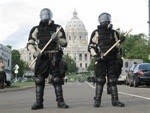 The scene in Acts 21 might best be described as a riot. The people of the city had lost all sense of the Temple worship, and had become a violent mob determined to put Paul to death. Their rage escalated to the point where the Roman soldiers had to almost beat them back, in order to pull Paul out of their clutches. We read, when they reached the stairs (the way of escape) Paul could no longer walk on his own, but had to be carried by the soldiers. It seems that even after the arrival of the soldiers, the crowd was still taking shots at Paul.
 It is common for people to show no interest in God until calamities arises. As long as life is going their way, they are not concerned with God, but as soon as things get difficult, suddenly, they cry to God for help. Those who have shown no interest in the ways of God, suddenly blame God for the calamity they are facing, and cry out to Him to fix everything.
 Jim Gallagher