Daniel 2:31-35
“You, O king, were watching; and behold, a great image! This great image, whose splendor was excellent, stood before you; and its form was awesome. This image’s head was of fine gold, its chest and arms of silver, its belly and thighs of bronze, its legs of iron, its feet partly of iron and partly of clay. You watched while a stone was cut out without hands, which struck the image on its feet of iron and clay, and broke them in pieces. Then the iron, the clay, the bronze, the silver, and the gold were crushed together, and became like chaff from the summer threshing floors; the wind carried them away so that no trace of them was found. And the stone that struck the image became a great mountain and filled the whole earth.”
 King Nebuchadnezzar’s dream serves as a timeline of world kingdoms, from the time of Daniel until the return of Christ. The image refers to six kingdoms, five that are temporary, and one that will last forever. Four of the six have already come and gone, while the final two are still in our future. The fulfillment of the first four gives us assurance of the fulfillment of the final two.
The first kingdom, represented by the gold head, was Babylon. It was a splendid kingdom with great power that seemed unconquerable, until a coalition of the Medes and Persians combined and defeated them. This second kingdom, represented by the chest of silver, spread to become the largest empire the world had ever seen, and ruled the Middle East for over two hundred years. Their expansion took them as far west as Greece. It was their attack upon Greece which led to their downfall. It was a young king from northern Greece who gathered the fractured city states, and overthrew Persia. Greece, the bronze belly, ruled the world until the rise of the Roman Empire, represented by the legs of iron.
The final two kingdoms are yet to come upon the world stage. Daniel uses the imagery of ten toes to describe a ten nation empire, somehow connected with Rome. This empire will rule until the time when the Kingdom of Christ is set up in the world. Jesus, seen as a large stone, will defeat world empires and set up His kingdom, which will be ruled with righteousness and governed with peace.
Today we live somewhere between two kingdoms. The world stage is becoming more and more global in its focus, and will soon begin to specifically fulfill the predictions of Daniel. The way to prepare for what is coming, is to become a citizen of the kingdom of God. John wrote,
John 1:12 “But as many as received Him, to them He gave the right to become children of God, to those who believe in His name”
Are you ready for the reign of Christ? Have you received Him, had your sins washed away and turned from your old life? Are you living for the Kingdom which is still to come?
Pastor Jim
 I remember the first time I heard someone teaching the parable of the ‘Sower and the Soils.’They referred to the person represented by the shallow ground as a “Firecracker Christian.” That is, someone who starts out with a bang, but burns out before too long. Sadly, the landscape is filled with believers just like that. It is refreshing to read that Daniel continued in his commitment to the Lord. His life becomes a good example of how to persevere in our walk with the Lord. There are a number of key components necessary for any who desires to remain committed until the end.
 As John begins to describe the fall of Babylon the Great, he hears a cry from heaven calling the people of God to come out, and no longer share in its sins. Babylon here is referring to more than a city in modern Iraq, it refers to the world system that is opposed to the ways of God. The call then is for the people of God to leave the ways of the world, to live in step with the ways of God. This is not a one time call, but is repeated time and again within the pages of your Bible. We were saved, not to continue in a destructive lifestyle, practicing the things that Jesus died to free us from, but to live a new life on a higher plain, where we seek in every area of life to bring pleasure to God.
 As the prophecies of Ezekiel come to a close, he describes the allotments of land that will be given to each of the tribes of Israel. It is striking to me that seven times in the chapter theses districts are called “holy.” The inheritance the Lord gives to His people is always holy, and the life we live should be lived in holiness.
 Jerusalem sits atop the mountain range known as mount Moriah. The city is surrounded by valleys, and is supplied with water through various springs, because there are no rivers that flow through the city or surrounding hillsides. Ezekiel is seeing into the future, to the time of the millennial reign of Christ. As Jesus sits upon the throne of David to rule the nations, the topography of Jerusalem is changed. A stream flows from the temple of God into the Kidron Valley, then turning south continues past the Hinnom Valley, heading toward the Dead Sea. What Ezekiel is seeing is both literal and symbolical. His vision is a beautiful picture of God, as the Source of life for a world that thirsts for spiritual truth, including forgiveness and salvation.
 As the angel explains the images John sees, he makes reference to the Book of Life. This book is mentioned again, in Revelation 20:15, as the guest list of heaven. All, whose names are written in this Book, will have access to heaven; those who do not, will be cast out to eternal judgment. If there is one thing you want to be certain of in this life, it is that your name is in the Lamb’s Book of Life. The question is, how do we get our names in that Book?
 Ezekiel is establishing some rules that will guide the people as they worship at the Temple. Some of these guidelines were clearly spelled out by Moses hundreds of years earlier, while others seem to be brand new. One such regulation required the people to leave the city from the opposite gate from which they had entered. If they came in from the south, they had to leave from the north, and vice-versa. No clear explanation is given, but it is not too difficult to draw some application for the believer today. Simply put, we should leave worship different than how we arrived.
 Recently, I was captivated by the different titles given to political leaders. In one news segment, I saw references to presidents, kings, prime ministers and even a supreme ruler. It is interesting the view men have of rulers. In some settings, they are seen as gods, while in other settings, servants of the people. Here, in Ezekiel, we get a glimpse into how God views those who rule over men. He sees them as representatives of Himself, and expects them to set an example for the people of what it means to be committed to Him. In God’s economy, a ruler of the people must first be a follower of YHWH. Israel’s greatest leader was described as a man after God’s heart (Acts 13:22). This evidenced itself in a desire to please God and properly represent Him to the people.
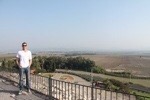 Recently, I had the privilege of standing on Tel Megiddo, the ruins of the ancient city of Megiddo. It overlooks, what is often referred to as, the valley of Armageddon. The experience was almost surreal. As I stood there, contemplating the events described in Revelation 16, I could see smoke rising in the distance, from tires being burned in protest to the fighting in Gaza and southern Israel. The silence of the moment was suddenly interrupted as the entire valley was filled with the roar of an Israeli fighter jet flying past. It was not difficult to imagine what the scene will be like when men gather in one last effort to eradicate God. Hundreds of years before Revelation was written, the Bible prophesied of this event.
 Ezekiel is given instructions concerning those who will serve the Lord in His Holy Temple. Three of the rules seemed to jump off the page as I read through them this morning.
 Jim Gallagher