1 Timothy 4:7-8
“But reject profane and old wives’ fables, and exercise yourself toward godliness. For bodily exercise profits a little, but godliness is profitable for all things, having promise of the life that now is and of that which is to come.”
If you are like me, you have probably seen a great number of motivational quotes posted on your Facebook wall. Things like “Pain is only weakness leaving the body” – “The secret of getting ahead is getting started.” – “It’s never too late to become what you might have been” – or “just do it”. While many of us might benefit from a little more exercise, ALL of us will benefit from a little more godliness. Paul is not suggesting that getting in better physical shape is a bad thing, but is contrasting it with the benefits of being in better spiritual shape. He speaks of the profitability of godliness.
Godliness is a term which means to be living in a way that is well pleasing to the Lord. The godly man is one who is not considering his personal happiness, comfort, or his own wishes, as the determining factor in his decision-making. Instead, he is making decisions based upon what God has revealed in His Word. Often, when faced with a conflict, an impasse, or a fork in the road, we are tempted to make our decisions solely based upon our own desires. That will often lead us away from what God has for us. The godly man will look into the Word to determine what God has to say on the subject and ultimately make decisions that will be well-pleasing in the Lord’s eyes. Paul speaks of the great benefits of living such a life.
First, he says godliness benefits us in this life. Many of the trials, pains, and scars we endure, are self-inflicted. They have been caused by getting off track and doing things our way, instead of God’s way. If we trace some of our difficulties back to their source, we will find they started with a decision to do what we wanted, instead of submitting to God’s Word. It is wonderful to know, God can always pick up the pieces of a broken life and do great things with it. We need only think of Legion, the naked, demon-possessed man who lived in the tombs, to see that God can always repair a shattered life that is surrendered to Him (Mark 5:2-15). However, it is also important to remember, much of the hardships of life can be avoided by surrendering all to Christ, and determining to live in line with His Word.
Second, he says godliness has great benefits in the life to come. While much of what heaven will be like is still shrouded in darkness, we do know that entrance into heaven is reserved for those who have trusted Christ for salvation. Jesus said He alone was the way and that no one can come to the Father except through Him (John 14:6). We also know, while entrance into heaven is a free gift received by faith, treasures are stored in heaven for those who live committed to Christ. Paul spoke of crowns that were awaiting the righteous. I do not pretend to know all the mysteries of heaven, but I do trust the words of Christ, who exhorted us to live this life in a way to be rewarded in the next.
Let’s be sure to commit ourselves to a daily exercise program that includes reading the Word, doing what it says, prayer, fellowship with other believers, and looking for ways to serve the Lord.
Pastor Jim


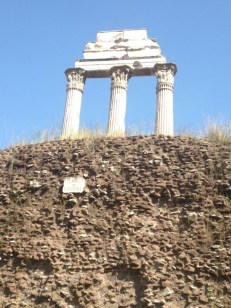 The church, designed by God, serves many purposes in the life of the believer. It is a place for corporate worship, where the gifts and talents of others enhance our expression of praise. The Bible alludes to the fact that our praises are like a sweet aroma, filling the courts of heaven. The church provides a place for corporate prayer. As Jesus instructed us, there is additional power behind prayer when we gather with others to offer our requests to God. The church is also a place for fellowship. God designed us as social beings. We achieve our best when surrounded by those whose lives propel us forward with godly examples. Scripture informs us, that fellowship with other believers is like a steel file sharpening a knife to make it more useful in the masters hand. When we surround ourselves with other believers, we are in a place where we can share each others burdens, encourage each other through struggles, and lift each other up when we fall. While there may be many more benefits we can derive from the church, Paul writes in this passage, about what we might call the primary purpose of the church.
 When archeologists discovered the remains of the ancient city of Jerusalem, which had been destroyed by the Babylonians, they discovered hundreds of small graven images or household gods. These images shed light on the fact that during the days Isaiah lived, idolatry ran rampant throughout the land. People filled their homes with images representing the gods they created with their own imaginations. Isaiah writes of the folly of idolatry. He describes a man planting a tree, waiting for it to grow, cutting it down, using a portion to build a fire to cook his meal, and the rest to shape into an image he will later bow down and worship. The gods that were created were the product of the imagination, and took the shape of the world in which they lived. The folly of idolatry is that we are both making god and worshipping god.
 Isaiah gives us two very different promises. First, he promises life will be filled with difficulty. He writes of passing through waters, facing floods, and raging fires. There are times when the road of life takes us straight into difficulty. We might be struck with disease, discomfort, heartbreak or tragedy. None of us are immune to any of these things. But Isaiah gives a second promise that is true for all who have trusted Christ. He declares that God will be with us in the midst of the darkest hours of life.
 Shakespeare’s character, Juliet, is famous for her statement, “What’s in a name? That which we call a rose by any other name would smell as sweet.” To her, a name meant nothing and love meant everything. Biblically speaking, there is much to a name. Throughout the Bible, God is called by a variety of names, each of which details certain aspects of His character. Here, Paul describes Him as, “God our Savior” and explains His deepest desire; “who desires all men to be saved.” The word desire means to take delight in, to love, and to determine to resolve. Paul is declaring that the determined purpose of God is for every person to be saved. He loves you, your family members, your neighbors, acquaintances and those who you have never met or been concerned. God’s desire is unlike our desire in that it does not stop with a wish or an ambition, but is worked out in action. It is because of the desire of God for all men to be saved that Paul goes on to say,
 The Bible teaches that we are fearfully and wonderfully made (Psalm 139:14). Our bodies, designed by God, are amazing machines. One of the more important functions of the body is the Central Nervous System. This elaborate system is responsible for communication between the brain and the members of the body. Information is passed to the brain through ventricles and the spinal cord. Although we may not understand the intricacies, we have all experienced the process. If I twist my ankle and the ligaments stretched beyond capacity, the injury is reported to the brain. The brain responds by telling the nearby muscles to be on high alert and treat the injured member with care. Simply put, God designed the human body to take care of the weak and injured members by treating them gently, and seeking to restore them to proper health. Isaiah reminds us that God feels the same way about the struggling believer.
 Life is filled with reasons to fear. We fear the unknown and the known, we fear change, and often fear that things will never change, we fear for ourselves, our families, and especially for our children. It would not take any of us very long to be crippled with fear, if we chose to dwell too long on any of those things. Isaiah is reminded, in the midst of frightening times, there are some pretty valid reasons not to fear. The first of the list is God’s promise to be with the believer.
 As Paul traveled the world to preach the Gospel, he had the great joy of seeing many come to Christ. Sadly, however, he also had the difficult experience of seeing some fall away from the Lord. Here he mentions two such individuals and describes their backsliding as being shipwrecked. They once had sails unfurled on course for the Kingdom, but had drifted off course and were no longer serving or following Christ. He mentions them as a warning to us of the dangers of falling away from Christ. A shipwreck is an appropriate analogy for the Christian because of the dangers we face on our journey towards what John Bunyan called “The Celestial City.” Unfortunately, shipwrecks, like backsliding, have a variety of causes.
 The Psalmist declared we are fearfully and wonderfully made (Psalm 139:14). The implication is that we were designed by God and everything about us is purposeful. We are the way we are, not by accident, but by design. God created us with weaknesses so we would have to rely upon His strength. One of those weaknesses is the fact that our bodies, like a motor, run out of gas and need to be recharged. No matter how strong we think we are, we get tired. Obviously, there are natural things we can do to “recharge our batteries.” At the end of each day, or perhaps even for a short period in the midst of it, we sleep. During that time the body has a way of strengthening itself. What looked impossible when we were tired, seems to be a whole lot easier with a fresh set of eyes. What we often forget is, in addition to rest, God has designed us with a need to wait on Him. He promises if we do, we will receive new strength which enables us to accomplish what He designed us to do.
 Jim Gallagher