2 Corinthians 13:5
“Examine yourselves as to whether you are in the faith. Test yourselves. Do you not know yourselves, that Jesus Christ is in you?”
 This verse carries two vital commands. First, we are told to examine ourselves, then we are told to test ourselves. Both carry the idea of looking at our lives in the light of the Word of God, to determine whether or not we are truly saved. Not all exams are of equal importance, but this is a test we must not avoid, or fail. What is at stake is not a low-grade in class, or the possibility of summer school, but where we will spend eternity.
“Do you not know yourselves, that Jesus Christ is in you?”
The first question on the test is whether or not you have received Christ. John wrote, “But as many as received Him, to them He gave the right to become children of God, . . .” (John 1 :12). He went on to explain that we receive Him when we believe. It is vital to ask yourself: have you recognized you are a sinner, that your sins have eternally separated you from God, and there is no effort that can be made on your part to remove those sins? Then we must realize, Jesus Christ went to the cross in order to provide a way for sin to be forgiven and removed. If you will look to the cross, confess your sin, and believe Jesus died for you, then Christ is in you.
“You believe that there is one God. You do well. Even the demons believe—and tremble!” James 2:19
Paul wrote to people who believed they were saved. Perhaps many of them went forward, responding to an altar call, or prayed with a prayer-team member after hearing a message of salvation. Some of those who prayed may have gone out the doors and right back into the sin-filled lifestyles in which they had been living. They may have placed their confidence for eternity in a raised hand or a walk forward. James reminds us, there is a faith that saves and a faith that does not save. Paul put it like this,
“ . . .that if you confess with your mouth the Lord Jesus and believe in your heart that God has raised Him from the dead, you will be saved.” Romans 10:9
Believing with the heart is more than making a one time confession; it involves the surrender of a life to Jesus. Heart believing is ‘trust in and reliance upon’. The person who has truly believed on Jesus, is the person who is walking after Him, and being changed by Him. “By this we know that we are in Him. He who says he abides in Him ought himself also to walk just as He walked.” 1John 2:5b-6
Another important part of this exam is to look at your life before and after you made a decision to follow Jesus. How has it changed? John spoke of two very important changes that will take place in a person who is truly saved. First, he spoke of us “walking in the light.” Darkness and light are often used in the Bible to speak of sin and holiness. We are told to cast off the works of darkness or to have no fellowship with the fruits of darkness, while at the same time, being told to walk in the light. Since receiving Christ, what sins have you cast off? Are you still looking at the same things, going to the same places, drinking the same stuff? Or have you begun to exam your life in light of the cross? The best way to cast off the works of darkness is to look at the life of Christ, and to live for the things that are pleasing to Him.
“Now by this we know that we know Him, if we keep His commandments.” 1 John 2:3
John mentions another vital question on our exam. He writes, the way to discern we know Him, is that we are doing what His Word says. As you read your Bible (which you should do daily) it is important, not only that you mark it, but that it marks you. You should allow the Bible to write on your life. How has your private life, family life, public life, and church life been changed by the daily reading of the Bible? Are you loving your spouse, raising your children in the things of the Lord, seeking to influence your neighbors, co-workers, and friends to follow Christ? Are you attending and serving at your local church? Simply put, are you letting God’s Word redirect your living? These are not things to take lightly. This is not an exam that you can afford to fail. It is critical that you honestly evaluate your life, not in light of what you think, but in light of what the Bible says, and ask yourself “Am I ready to face eternity?”
Pastor Jim
 A few years ago, I stumbled across a pretty cool website designed to help create photo albums. In a few minutes, I was able to design a picture book capturing a recent family trip. Ecclesiastes is a bit like a photo album, capturing the travels of Solomon, in pursuit of the meaning of life. Solomon had the unique combination of great wealth and intellect. As a result, nothing was beyond his reach as he searched for the meaning of life, in the midst of living. His journeys took him down many different roads. Sadly, he found no matter what road he traveled, he seemed to end at the same destination. A place he called “Vanity of Vanities.”
 Most of us have heard the description of optimism verses pessimism, where we look at the glass as either half full or half empty. Reading the words of Solomon, he seems to have become a guy who believes the glass is not only empty, but is broken and shards of glass are protruding into his skin. His assessment of life is that it is empty and nothing can make it better. He has come to this conclusion by observing nature and his own personal experiences. Looking at nature, he found, no matter what happens, the sun still rises, and though the rivers run into the sea, it never overflows. His personal experience showed him that no matter how much he looks, his eyes still desire to see more. I can’t really fault Solomon. I think, looking at what is happening in the world today would bum most people out, and even create in us a rather cynical view of life.
 Every few years someone writes a book about how they died, went to heaven, and returned to tell about their experiences. The story usually includes something about radiant light, warm feelings, and the awareness of all their loved ones awaiting their arrival. The authors are heralded as experts on the subject of the after-life and their books often become best sellers. Two thousand years ago Paul had an experience where he was “caught up” into heaven. As he reluctantly relates his story, two things stand out to me.
 Job lost his health, wealth, family and friends, yet he “Did not sin nor charge God with wrong” (Job 1:22),No matter what the devil threw at him, he remained faithful to the Lord. When his wife told him he should curse God and die, he responded, “Shall we indeed accept good from God, and shall we not accept adversity?”(Job 2:10) We are told “In all this Job did not sin with his lips.” However, by the end of the book, Job, in fact, sinned and charged God with doing wrong. It wasn’t his circumstances or the attacks of the devil that led Job to sin, but the treatment he received from his friends. What Satan was unable to do, his friends did. Their treatment led him to sin with his mouth. It is no wonder Job declared,
 Job 40:15 “Look now at the behemoth, which I made along with you; He eats grass like an ox.”
 Part of the reason for writing this letter, was Paul’s authority as an apostle was being challenged. When he came to Corinth, Paul chose not to receive a salary from the Corinthian church, instead he worked with his hands, and received support from the churches in Macedonia. He also chose not to use his great intellect or skills as an orator to persuade the people, but resolved to emphasize the simplicity of Christ, and relied upon the work of the Holy Spirit. As a result, after his departure, many ridiculed him and his teaching, calling his authority into question. Rather than responding to the criticism by referring to the seminary degree, the books he had written, or churches he started, Paul reminds them of the difficulties he faced in order to bring the Gospel to a lost world. This passage was admittedly difficult for the Apostle to write. He was not one who derived pleasure from boasting of his own accomplishments. As difficult as it may have been, I am glad he wrote it. For it reveals the hardships he was willing to endure for others to come to Christ.
 When Job’s counselors accused him of wrong, he began to justify himself before them. They claimed he was a sinner, so he declared his righteousness. As this argument continued to develop, Job’s justification began to cast blame upon God. If Job was innocent, then God must be wrong for allowing these things to happen to him. Perhaps this was the earliest development of the accusation we offer hear today, “how could God allow bad things to happen to good people.”
 Job was confused. He did not understand how God could allow so much suffering in his life. When God finally speaks to Job, He asks a simple question, “How long is the pregnancy of a deer or a goat?” These are not difficult questions. They could easily be answered by observing nature. Yet, it seems Job did not have the answer. To be quite honest, I didn’t know either, and had too look it up. Why would God ask him that question? What does the birth cycle of wild animals have to do with the trials Job was facing? I think the answer is found in a question Jesus asked Nicodemus.
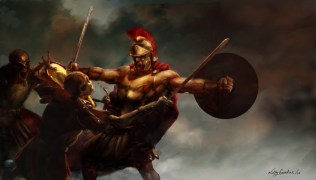 The word ‘walk’ is a common idiom in the New Testament used to illustrate the way we live. Paul is reminding us that whether we are believers or not, we live in the natural world. Believer and unbeliever alike, breathe the same air, eat the same food, and need the same rest. Having said that, Paul goes on to remind us that, although we live in the natural world, we fight a spiritual battle. He does not use the word WAR, as a hook for his sermon, instead he is describing the everyday life of the Christian. From the moment we rise each and every day, we are in the midst of spiritual battle. One of the factors making this battle so difficult, is that it takes place on two fronts. We all battle against our own flesh. We must fight to resist temptation, overcome sin, and live as godly ambassadors of Christ. At the same time, we are battling to see our friends, family, neighbors co-workers, and acquaintances come to Christ. These battles are not won by natural means, but with spiritual weapons.
 Jim Gallagher