1 Kings 10:14
“The weight of gold that came to Solomon yearly was six hundred and sixty- six talents of gold, . . .”
 Webster’s dictionary defines numerology as “the secret meaning of numbers.” Clearly, as we read through the Bible, we find specific numbers used to emphasize certain truths. The number seven seems to speak of a complete cycle, and is used to illustrate perfection. In the book of Revelation, we read of the “Seven Spirits of God”, which does not mean there are seven Holy Spirits, but refers to the perfect work of the Spirit. The number forty seems to speak of judgment. The children of Israel spent forty years in the wilderness because of their sin, and Paul was beaten by the Jews “forty times minus one.” One was subtracted to show mercy, thus thirty-nine became a number for mercy. In the book of Revelation, we are told that six is the number of man, and the number of the “beast” is 666.
Revelation 13:18 “Here is wisdom. Let him who has understanding calculate the number of the beast, for it is the number of a man:His number is 666.”
We cannot help but notice the amount of gold delivered to Solomon every year, is the same in number as that of the beast of Revelation. The question we have to ask ourselves is, “What does that mean?” Is there any significance to the use of the number here? I think the answer is, “I don’t know.” While every reader familiar with Revelation would certainly pause and notice the similarity, no further information is given. None of the New Testament writers remark on Solomon’s gold, as it relates to the number 666. I think we must simply conclude that the intent of the Spirit was to draw our attention to the fact that Solomon’s sin, of trying to find life in possessions, was fueled by the work of the devil.
I think this brings up a very important point, as it relates to Bible study. We want to be very careful, as students, to examine our Bible, and let it speak for itself. We will run into danger when we project meaning into verses that were not meant by the original authors. Instead of always trying to find a hidden meaning in the Scriptures, we should be looking for the obvious meaning and spend our energies putting that into practice.
Pastor Jim
 A number of years ago, I came home from a long day of work, at the end of an even longer week. I was worn out and hungry. Since I was the only one home at the time, I was facing a battle within. My stomach insisted on being fed, but the rest of me demanded rest. Too broke to order out, and too tired to fix a meal, I laid down on the couch and began flipping the channels. I stopped on a show called, “Lifestyles of the Rich and Famous.” This a series that displayed the possessions of extremely wealthy individuals. If memory serves me, this was the only time I had ever seen the show. The episode followed the life of a the king of a small Middle Eastern country, whose name I have forgotten. While his subjects lived in poverty, he was one of the wealthiest men alive. They showed his palace, which was the size of a small college campus. What really got my attention, however, was when he traveled to the U.S. He wanted to stay in a particular room in a hotel in Beverly Hills, but the room was booked. Instead of finding another room, or another hotel, he bought the hotel, remodeled it to his liking, and stayed in the room of his choice. Lying there on the couch, I was struck by two contrary things. The first was this man’s great wealth, the second was how it had no effect on me whatsoever. I was still too broke to go out and too tired to cook.
 Seven years, hundreds of thousands of man hours, and countless wealth, was invested in the building of the Temple. When it was completed, it was one of the most glorious buildings of the ancient world. The best architects, builders, artists, and specialist had been commissioned to accomplish a feat that still boggles the minds of historians today. One can only imagine what it must have been like to stand on the Temple mount, looking up at this glorious building, and looking down upon the city of David. Yet, with all it’s splendor, Solomon is struck with the realization, it is simply way too small.
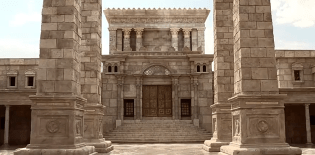 Four hundred and eighty years after entering the promised land the Tabernacle was replaced with the Temple. The Temple was an elaborate structure, sitting above the city of David, on what had been the threshing floor of Ornan. This forty five foot tall building was the prize of Israel, and could be seen from miles away. The inside of the Temple was even more glorious than its exterior. The floor, walls, and ceiling, were made of intricately carved cedar and overlaid in gold. The rooms were decorated with tapestries and furnishings designed by God, and built by he finest craftsmen of the time. It is no wonder the whole nation gathered to celebrate when the Temple was finally completed.
 In the early eighties, a well-known Christian band wrote a song called “God Rules.” In some ways, it became the anthem of many young Christians. I remember having a “God Rules” bumper sticker on my car, and proudly writing it on my school notebook. To me, that phrase was a slang term meaning little more than the fact God was best. I believe the Psalmist is saying much more than that, he is speaking of the sovereignty of God. The word sovereign means ‘to possess supreme power.’ David is declaring that God has supreme power over His people.
 Building the Temple was a massive undertaking. It was to be a structure like no other. Unlike the pagan temples that were built in an attempt to reach up to the gods, this temple was built so God could reach down to man. The entirety of this structure pointed to the fact that God made a way for sinful man to have relationship with a holy God. As soon as a person approached the temple, they would smell the sacrifices, and be reminded of their need for a substitute to die in their place; removing the guilt and penalty of sin. These sacrifices provided a temporary covering, and pointed forward to Christ, who would die once, for the sins of all. Without question, this was the most important building of the ancient world.
 No matter where we live, we are faced with the storms of life. Growing up in California, I was constantly reminded of the great earthquake that was looming on the horizon. We were told that because of the fault lines, one day California would fall into the sea. Upon moving to Florida, the new fear was the hurricane. A few years back, a particularly large hurricane had developed in the warm waters of the South Atlantic. The atmospheric conditions were such to allow this storm to grow larger and larger as it traveled north. All of the models had it making landfall just outside of my home town. Having never experienced a hurricane before, I was glued to the Weather Channel for information. A hurricane this large had never been tracked before; it was larger than the state of Texas, and had wind speeds over 140 mph. People up and down the coast of Florida, Georgia, and South Carolina were heading west for safety. One news station reported that hotels, as far as Kentucky were filling up, as people searched for a safe place in the storm. I felt stuck. I did not know where to go. In a last-minute decision, we drove across the state and stayed with friends, figuring though we might not be avoiding the storm, at least we would have the comfort of going through it together. Fortunately, the storm moved north, missing Florida all together, and reducing in size drastically as it met cooler waters. I came to the realization, no matter where we live, we are faced with the storms of life, and must determine where we will run for safety.
 Solomon was known for his great wisdom. We are told his understanding of psychology, botany and biology surpassed the great teachers of his day. We find people from all over the Middle East would travel to hear him speak, and when they left, they declared that the rumors of his intellect did not do justice to how brilliant he really was. The most remarkable thing about his abilities is where they came from. As we read his Biblical biography, we find these gifts were God-given and purchased through prayer.
 Throughout his life Solomon showed evidence of his love for the Lord. He wrote three thousand proverbs to instruct young men how to walk pleasing to the Lord. Although only a few remain, we are told he also wrote over one thousand songs. Because of the influence of his father, it is safe to say, most of these would have been songs of worship. Solomon also spent the early years of his reign building the Temple, so Israel would have a permanent structure in which to worship he Lord. All of this attests to the statement that, “Solomon loved The Lord.” The problem arises when we continue reading the verse and find, along with his love, he had what the text calls “an exception.” Solomon loved The Lord except…”
 This Psalm is a prayer set to music. In It, David is crying out to God to deliver him from those who are seeking to end his life. The title of the Psalm gives us insight into the situation he is facing.
 Jim Gallagher