Psalm 69:1-2
“Save me, O God! For the waters have come up to my neck. I sink in deep mire, where there is no standing; I have come into deep waters, where the floods overflow me.”
 This Psalm is fulfilled in at least three ways. First, it expresses an actual time in the life of David. His enemies have mounted up against him with such great force that he feels like one who is drowning in a mighty flood. The enemies he faces are those who have sided with Saul, to seek his life; those who were against him because he had chosen to follow God, and finally, and perhaps his greatest enemy, is his own sin. In the midst of the battle for his own life, sin had mounted up like an army, seeking to destroy him. David’s victory over these enemies is found as He seeks the mercy of God. He writes, “Hear me, O Lord, for Your lovingkindness is good; turn to me according to the multitude of Your tender mercies.” Psalm 69:16
Second, this Psalm has fulfillment in the daily life of the child of God. At times, we find ourselves facing enemies far greater than ourselves. Trials can be like a mighty force that we cannot overcome; there are even times when people turn against us. Like Job, when we need someone the most, we often feel like we have been deserted. However, the greatest enemy, the one that wages the most intense battle against us, is personal sin. We all know those times when our easily besetting sins seem to mount an offensive so great that we wonder when we will be taken down. It is in those times, we must follow the example of David, and look up to Heaven’s throne of Grace and cry out, “Hear me, O LORD, for Your loving-kindness is good; turn to me according to the multitude of Your tender mercies.”
Finally, this is another of the Messianic Psalms. It has it’s fulfillment at the Cross of Christ. Verse twenty-one draws our attention to the crucifixion; “They also gave me gall for my food, and for my thirst they gave me vinegar to drink” (Psalm 69:21). Jesus was also surrounded by enemies. The enemies He faced were the religious leaders, Roman soldiers, a multitude of onlookers, and even some who had once followed Him. They were all now crying out for His execution. When Peter explained the events of the crucifixion in Acts 2, he made it clear that it was not the Romans, or even the Jewish leaders, who were responsible for the execution of Christ. He said to a group of people, many who had traveled from a distant land, and were not present at the death of Christ, “ . . .you have taken (Him) by lawless hands, have crucified, and put to death” (Acts 2:23). Jesus went to the cross to satisfy the wrath of God. His death provided a way for the insurmountable forces of sin to be conquered, and eternal life to be provided. Our cry for mercy can be answered because of the atoning death of Christ. Even when our sins wage war against us, and it seems like a force too great to withstand, we can cry out to heaven for mercy, forgiveness and victory.
Take time to look to His mercy today.
Pastor Jim
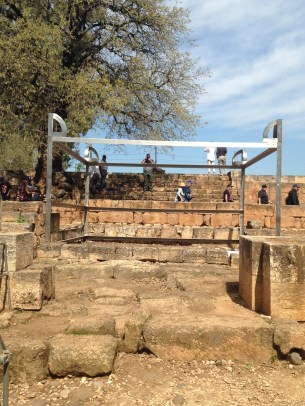 If a traveler from a distant land were to arrive in Israel during the reign of Ahab, there would be little to convince him that these were a people chosen by God. If he entered from the north, the first thing to catch his eye would have been a massive altar built on a high hill in the area of Dan. This altar was erected to give worship to a massive golden cow the people revered as their god. If he came from the south, he would see a similar site erected in Bethel. If he made his way into the heart of the nation, to the newly built city of Samaria, he would find the focal point of the city was an altar built to Baal, the god of fertility. If our traveler were to continue through the towns and villages of Israel, he would see a wide variety of altars and high places built to almost every imaginable god under the son. Essentially, Israel had deteriorated from a nation whose purpose was to glorify YHWH, and be a beacon of light to the world, to a nation just like their neighbors. They had all the same problems, and addressed them with all the same solutions, as those who had never met the Lord.
 We recently had a friend visiting who we had not seen in a number of years. One of his first comments was how much our children had grown. When he last saw them, they were pre-teens, now they are young men. He was shocked at how they had changed, in what seemed to be such a brief period of time. For us, the changes do not seem quite as drastic, because we are watching what happens from day to day. It is only when we bring up a photo or video that we see how much things have really changed.
 The physical battles Israel faced illustrates the spiritual battles the Christian faces.
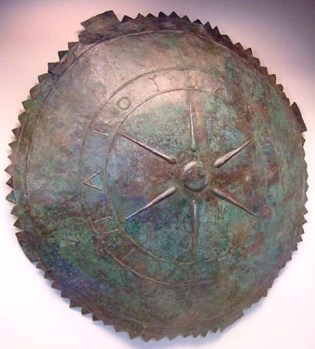 Rehoboam is known for being the king that split the nation of Israel. His greed drove him to make decisions that ultimately divided the kingdom. Sadly however, this was not the worst policy he implemented. During his seventeen year reign, he continued to ignore the Word of God and to introduce idolatry to the nation. As a result, this once powerful nation fell prey to their enemies. Like a shark smelling blood in the water, Egypt saw the weakness of Israel and sent troops to Jerusalem. Their armies easily overcame any and all resistance and began to loot the city. Just a few short decades after the Temple was completed, it was ransacked by foreigners and its prize articles were stolen. Among the items Shishak took, were the golden shields that hung as a symbol of Israel’s strength. Rather than turning to God, Rehoboam decided to hang bronze shields in their place. After all, from a distance, who would really be able to tell the difference. What a different story this would have been if Rehoboam would have fallen on his knees and turned back to the Lord.
 Jeroboam had been called and anointed as king of Israel. He was given the same opportunities and promises that David was given. His problem was, instead of drawing near to the Lord, he followed the gods of the surrounding nations, and turned Israel away from the Lord. God, in His unparalleled mercy, sent an unnamed prophet to win Jeroboam back to the ways of the Lord. The man of God declared a powerful message of rebuke to the king; and with a stunning show of the power of God, the altar split in two. Jeroboam’s heart had become so hardened, his response was to demand this young man be imprisoned. As the king’s hand stretched forth condemning the prophet, his hand suddenly withered. With a withered hand, and a broken altar, the king pleaded with the prophet to pray for him. Sadly, his prayer was not one of repentance, he simply wanted things restored to the way they were.
 Have you ever noticed, when movie stars are walking the red carpet, for one of their many awards presentations, they are not asked what they are wearing, but who they are wearing? One of the marks of success is getting a particular designer to make you a one-of-a-kind outfit.
 A youth pastor I once knew had a plaque posted on his wall that read, “Hire a teenager while they still know everything.” Every parent and high school teacher can attest to the fact that young people are often stubborn and insist they know better than the generations that have gone before them. I think part of this is God given and healthy. I think there is great value, especially to the church, in allowing a fresh set of eyes to give us a different perspective on how to best approach ministry. That being said, I also believe this can be unhealthy, and even destructive, when it is not curbed and directed by the wisdom of those who have walked before us.
 It is almost eerie to compare the similarities between Solomon and Saul, and Jeroboam and David. As a result of personal sin, Solomon, like Saul, had the kingdom taken from him. While Jeroboam, like David, was chosen by God, to rise to the challenge and lead a new nation. Sadly, both men failed miserably. The root cause of Solomon’s sin is explained earlier.
 Have you ever had one of those times when you are craving something, but you are not sure what it is? When that happens to me I tend to keep trying things, in an attempt to satisfy a craving that I cannot define. What is true with physical hunger, is also true in the spiritual realm. God created us with a need for Him. This need evidences itself with a desire to find meaning in life, answers to what lies beyond this life, and a craving to worship.
 Jim Gallagher