Isaiah 58:6
“Is this not the fast that I have chosen:
To loose the bonds of wickedness,
To undo the heavy burdens,
To let the oppressed go free,
And that you break every yoke?”
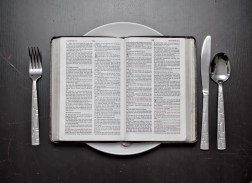 In one of His longest recorded sermons, Jesus spoke of 3 spiritual exercises that every believer should be practicing. He spoke of giving, praying and fasting. Fasting is the practice of giving up food for a period of time in order to learn to deny ourselves and to devote more attention to the things of God. Sadly, instead of viewing fasting as a way to draw near to God the people in Isaiah’s day were treating it as a religious responsibility. It was almost as though it was part of their checklist. They felt that fasting itself made them spiritual and they saw little need for their lives to be affected by their professed relationship with God. Isaiah declares that a real fast will will give evidence of a transformed life.
William Booth was the man behind the Salvation Army. About one hundred years ago he was asked what he thought were the greatest dangers the church was facing in the years ahead. His response is quite intriguing. He said:
“The chief danger that confronts the coming century will be religion without the Holy Ghost, Christianity without Christ, forgiveness without repentance, salvation without regeneration, politics without God, heaven without hell.”
In other words he spoke of a form of Christianity that has little impact upon the way a person lives their life. He foresaw churches filled with people who raise their hands in worship, drop checks in the offering box and perhaps even sign up for ministry opportunities yet they fail to allow the Spirit of God and the Word of God to transform their lives.
Instead of emphasizing religious duties we should be seeking to become like Jesus in every possible way. A real commitment to Christ will show itself in a life that is changed.
Jim
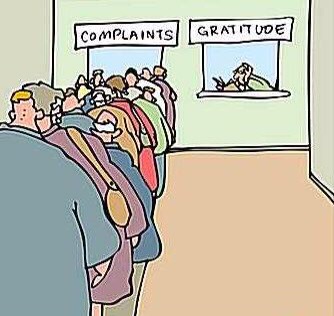 Complaining is often the result of looking at the one thing that is going wrong instead of the many things that are going well. We might have a day off work, be gathering with our family at a park or at the beach, and instead of enjoying the day we begin to complain that it is too windy, too hot or there are too many others who chose to spend the day at the same location. Instead of looking at all that is right we becoming fixated with what we perceive to be wrong. Another common problem associated with complaining is that we often bring our complaints to the wrong place. When we are upset about our job we complain to our spouse, when we have a problem associated with the kids school or their sports team we complain to our friends. Instead of bringing our complaint to the source who can resolve it, we simply like to complain.
 Sometimes it is difficult to uncover the meaning behind a biblical text or to make proper application for our lives. Other times, there is no difficulty at all. Three times in this text we read the same phrase,
 When Solomon first stepped onto the throne of his father, David, he was overwhelmed by the task before him. He realized he was weak and inexperienced, and the responsibility of ruling the nation was too much for him to handle. He knew that the Lord was his only hope, and cried out to God for wisdom. This psalm is a poetic expression of an event recorded in 1Kings 3. There, we find Solomon encountering God in his dreams. Faced with the overwhelming task of leadership, God allows Solomon to request anything he wants. Solomon’s reply is essentially the same as is recorded here. He asks for wisdom to know how to lead the nation.
 Life hurls a vast array of difficulties at the child of God. We are struck with the common problems of every man, as well as those that are peculiar to attempting to follow Jesus, in the midst of ever increasing ungodliness. The question we are faced with is, where will we flee for safety, guidance and solace when struck by the trials of life? David thought it utterly preposterous to think of fleeing to the mountains for aid. To him, it was the Lord, and the Lord alone, who would be his defense.
 The Psalmist points out at least four characteristics of the wicked. First, he declares that they do not think about God. One of the surest ways to live a life that pleases the Lord is to consider Him before you act. If you take the time to ask yourself, “What does God think about this?” you will find that you begin to make better and wiser decisions.
 This chapter contains one of only two narrative passages in the book of Leviticus and tells the story of two men who were fighting. One man, the son of Shelomith allowed his anger to lead to sin and he blasphemed the name of the Lord. Under the old covenant this was a crime punishable by death. Because of the seriousness of his actions, he was placed in custody while the leaders took the necessary time to seek the mind of the Lord. Two important principles stand out to me.
 The book of Malachi brings the Old Testament to a close. For a period of 1,100 years God at various times and in diverse manners spoke to His people through the prophets. That time had now concluded and for the next 400 years heaven was silent. It was not until the angel appeared to Zechariah and Elizabeth, that this silence was broken. Knowing that this time was coming, God exhorted the people to think back upon His written Word.
 Wisdom can be defined as the proper application of knowledge in any given situation, or simply knowing what to do. We have all felt, at times, that we do not know what to do. We are faced with a problem, and are crippled with indecision. It is comforting to know, God promises to give wisdom to His children. The question that remains is, how do I get my hands on the wisdom He has? There are at least three simple steps.
 A few years back I attended a men’s conference where this verse was shared during a worship session. Like most, I was encouraged by the sentiment of it, until I recalled the context. You see, as beautiful as the verse is, it is declared by a group of people who have no real intention of doing what the Lord says. The verse might better read, “we will obey as long as the Lord tells us what we want to hear.”
 Jim Gallagher