1 Kings 14:26-27
“And he took away the treasures of the house of the Lord and the treasures of the king’s house; he took away everything. He also took away all the gold shields which Solomon had made. Then King Rehoboam made bronze shields in their place, and committed them to the hands of the captains of the guard, who guarded the doorway of the king’s house.”
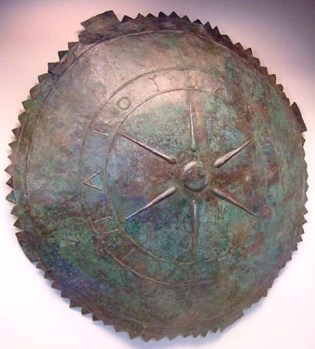 Rehoboam is known for being the king that split the nation of Israel. His greed drove him to make decisions that ultimately divided the kingdom. Sadly however, this was not the worst policy he implemented. During his seventeen year reign, he continued to ignore the Word of God and to introduce idolatry to the nation. As a result, this once powerful nation fell prey to their enemies. Like a shark smelling blood in the water, Egypt saw the weakness of Israel and sent troops to Jerusalem. Their armies easily overcame any and all resistance and began to loot the city. Just a few short decades after the Temple was completed, it was ransacked by foreigners and its prize articles were stolen. Among the items Shishak took, were the golden shields that hung as a symbol of Israel’s strength. Rather than turning to God, Rehoboam decided to hang bronze shields in their place. After all, from a distance, who would really be able to tell the difference. What a different story this would have been if Rehoboam would have fallen on his knees and turned back to the Lord.
Often, when a person begins to backslide, their response is much like Rehoboam’s. Instead of addressing the real issue and focussing upon returning to the Lord, they begin to pretend that everything is fine. Church attendance continues, they may even keep talking the Christian lingo, but they have stopped abiding in Christ and begun to drift from Him. If that describes you, don’t hang bronze shields on your wall, pretending that everything is OK. Call a friend, confess whatever sin you are struggling with, and get back to walking with the Lord. Remember, His mercies are new every morning
Pastor Jim
 Some confusion has arisen from the two seemingly contradictory records of the death of Saul. 1 Samuel closes by recording the incident, and explaining that a wounded Saul, no doubt fearful of being captured, tortured, and brutally killed, fell upon his sword, taking his own life. Now, as 2 Samuel begins, we read that in agony, Saul pleaded for a young Amelekite to end his life. The law of contradiction is not broken by joining the two accounts, and concluding that when Saul fell on his sword he did not die immediately. So he pleaded with the young man to end his suffering. However, based upon the account in 2 Samuel there seems a more likely conclusion. This young Amalekite was something of an opportunist, and lied about what actually happened.
 Jim Gallagher