Hebrews 3:12-13
“Beware, brethren, lest there be in any of you an evil heart of unbelief in departing from the living God; but exhort one another daily, while it is called “Today,” lest any of you be hardened through the deceitfulness of sin.”
 Life is dangerous and filled with pitfalls. We are constantly warned to be on the lookout for danger. We see signs warning us that the road is slippery, the coffee is hot, there is a low beam, animals may cross the highway; riptide, sharks, jellyfish and high surf face us in the ocean. Paul reminds us of a hazard that is far more dangerous because it has taken many more away than any riptide ever has. He warns us against having a hardened heart. Biblically speaking, a hard heart could be defined as being unwilling to do what God asks. This was the primary issue with the pharaoh in Moses’ day. He clearly heard the word and will of God, yet he was unwilling to submit to it and fought against God. This proved costly to him, as it always will to us. Our text reveals three things we must avoid because they will result in a hardened heart.
First, we are warned against unbelief. Unbelief is simply not trusting the Word of God, whether it is warning, instructing, or providing us with promises. Israel in the wilderness is cited as an example of unbelief. God promised them victory as they entered the land, yet they cowered in fear and refused to enter. Looking at their circumstances, instead of looking to the Lord, resulted in unbelief that led to a hardened heart. We can avoid our hearts hardening by taking God at His word and doing what He asks.
Second, we are warned against departing from the living God. Departing means to move away. The closer you are to Jesus the easier it is to trust Him. Mark records the story of Jesus turning water into wine at a wedding feast, where the host had run out of refreshments for the guests. When word came to Jesus, he sent his disciples to fill large contains with water from the local well. Upon arriving back at the party, the water was served but had miraculously been turned into wine. The guests were unaware of what had been accomplished, but those closest to Jesus experienced the miracle. Close proximity to Jesus is always beneficial to walking with Him. James exhorts us to draw near to God and He will draw near to us (James 4:8).
Finally, we are warned against our hearts becoming hardened by sin. Sin is doing what God has forbidden. We often sin because, from our limited perspective, we cannot see why something is bad. This is very common in relationships. We see many Christians get involved with someone who is not pursuing the Lord, but is a very nice person. They cannot understand why that is forbidden. Others cross the line physically, because they believe they are in love and convince themselves that sexual activity is acceptable. In every case, sin leads to a hardened heart and must be avoided. Be very careful that you do not cross verses out of your Bible, in order to justify your behaviors.
Let us not harden our heart, but keep it soft to hear all the Lord has to say to us.
Pastor Jim
 Israel, in Isaiah’s day, was in dire straights. The Assyrians were on a rampage, overthrowing any nation that stood in the way of their desire for global dominance. Israel watched as their neighbors were defeated and enslaved to the most bloodthirsty nation the world had ever known. In the midst of these threatening conditions, people began to offer solutions. The most common was to make an allegiance with Egypt to withstand the Assyrian invasion. Isaiah offered an entirely different remedy. He encouraged the people to understand, it was God who could save them. But in order for this to happen, they would have to look at Him very differently than they had been doing. He used three words to describe a proper relationship with God.
 A few days ago I was working at my computer using a program that had been updated with new features. While I had used the program before, these new features added elements with which I was unfamiliar. I was having trouble with what should have been a pretty simple task. Each time I tried to make it do what I wanted, the program would override my action, doing something else to the document. In frustration, I called out for help from one of the other pastors, who is quite computer savvy. When he came to my aid I said, “This stupid thing is not working.” To which he replied. “That’s because you are doing it wrong.” After a moment of being offended, I realized he was right and I humbled myself allowing him to show me the correct way to work the program. I was delighted to find it was not the program that was being stupid, and the upgrades were actually quite helpful. But what does that have to do with our text?
 The book of Ecclesiastes is a bit like an experiment. Solomon looked at life the way a scientist does an experiment. He sought to discover the meaning of life by asking questions, doing research, creating an hypothesis, and drawing a conclusion. It is here, at the end, that he makes his discovery known to his readers. His conclusion, after years of experimentation, is that the purpose of life will be found in fearing God and keeping His Word.
 It is not uncommon for a person to go from church to church, and pastor to pastor, until they receive the counsel they want to hear; instead of the counsel they need to hear. I have known people to leave the church they have been attending simply because they received advice or admonishment they did not like. It is in those times, Solomon’s words seem to be most fitting. He declares, we are free to do whatever our heart desires, but we must understand, a day is coming when we will give account for those decisions, and the actions that followed.
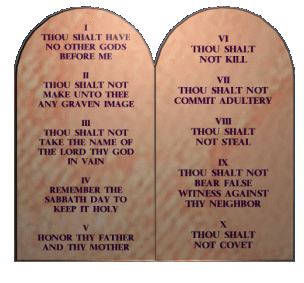 The law Paul refers to is what is commonly known as the Ten Commandments. This law is distinct from all other laws in its source and in its purpose. We are surrounded by laws written by men and designed to be kept. The Law of God was written by the hand of God; its purpose, to reveal that we are incapable of living up to His standard of righteousness. When confronted with the Gospel, many will claim they are good people, trying to honor God by keeping the commandments. Anyone who makes that statement, completely misunderstands the commands of God. Let’s take a look at a few of them and see how we measure up.
 This verse carries two vital commands. First, we are told to examine ourselves, then we are told to test ourselves. Both carry the idea of looking at our lives in the light of the Word of God, to determine whether or not we are truly saved. Not all exams are of equal importance, but this is a test we must not avoid, or fail. What is at stake is not a low-grade in class, or the possibility of summer school, but where we will spend eternity.
 Job was confused. He did not understand how God could allow so much suffering in his life. When God finally speaks to Job, He asks a simple question, “How long is the pregnancy of a deer or a goat?” These are not difficult questions. They could easily be answered by observing nature. Yet, it seems Job did not have the answer. To be quite honest, I didn’t know either, and had too look it up. Why would God ask him that question? What does the birth cycle of wild animals have to do with the trials Job was facing? I think the answer is found in a question Jesus asked Nicodemus.
 I am sure each of us has felt this way at one time or another. We might be going through a particularly difficult season of life, and it seems God is hiding in the shadows. We may look in all the obvious places and not seem to be able to find His purposes in what we are facing. I think it is valuable to notice that righteous Job, not only experienced this same dilemma, but gives us the steps he took along the way. There are four important steps he took when it seemed God was hiding.
 Isaac Newton is credited with discovering certain laws governing the natural world. These laws cannot be broken. The law of gravity simply states, what goes up must come down. We prove that to be true each time we toss something into the air and watch as it lands back on the ground. Just as there are natural laws determining the course of nature, so there are spiritual laws that will determine the course of our lives. One of those laws is expressed here.
 Jim Gallagher