Jeremiah 19:1
”Thus says the Lord: ‘Go and get a potter’s earthen flask, and take some of the elders of the people and some of the elders of the priests.'”
 Jeremiah 19:10-11 “Then you shall break the flask in the sight of the men who go with you, and say to them, ‘Thus says the LORD of hosts:’ “Even so I will break this people and this city, as one breaks a potter’s vessel, which cannot be made whole again; and they shall bury them in Tophet till there is no place to bury.””
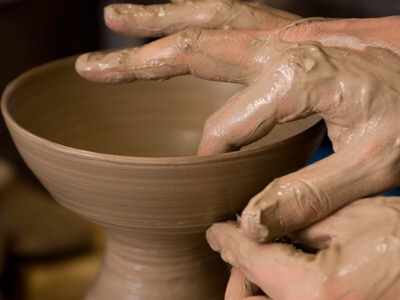
Sometimes Jeremiah not only taught the Word, but he also illustrated it quite graphically. On this occasion, he was to take a flask in his hands as he spoke to the people. They would see themselves as the earthen vessel that had been created by the potter. At some point in his message, he cast the flask on he ground and the people watched as it shattered into pieces. These shards of pottery now spoke of the broken lives of those who continued to resist the Lord, and stubbornly followed the dictates of their own hearts. It does not take a genius to realize, it would be better to have a life like a beautiful piece of pottery, than a broken shard of clay.
Instead of resisting the Lord and fighting against His word, we should submit to His ways, no matter how counterintuitive they may seem. When we do, we are allowing ourselves to sit on the potter’s wheel and be shaped into His image. There is nothing greater than to be transformed into a vessel that is useful to the Potter.
2 Timothy 2:21 “Therefore if anyone cleanses himself from the latter, he will be a vessel for honor, sanctified and useful for the Master, prepared for every good work.”
Pastor Jim
 Solomon’s expansive building projects did not come cheaply, and had a devastating effect upon the nation of Israel. The people sat under a heavy yoke of taxation. After Solomon’s death, the people had enough. They sought relief from the tax burden the government had imposed on the nation. Young King Rehoboam, in his arrogance, believed the government knew better than the people, and rather than relief, he promised an increase in the tax burden, and workload of the people. His words drove the citizens to rebel against his leadership, and resulted in ten of the twelve “states” separating from the union. The northern tribes formed a new nation, and this became their independence day. Having experienced a heavy yoke, they broke away in order to have freedom. Sadly, the northern tribes never experienced true freedom. Soon after the nation was formed, they set up a system of idolatry, leading the people into a bondage that was much worse than the taxation they had experienced. Their example speaks volumes to us about bondage and true freedom.
 As I read through 1Chronicles, I am struck by the heroic actions of those who served alongside king David. His reign led Israel to the height of their success as a nation, and resulted in establishing peace with the surrounding nations. This success was not accomplished alone, but was a result of heroic men who stood tall in the midst of great difficulty and opposition. This seems to always be the case. One person put it this way, “Heroes are not born they are made”, and it is clear it is the circumstances they faced that made their actions heroic. In other words, Heroes are made when men and women stand up against insurmountable odds and risk their own lives for the sake of others.
 As the sun begins to set on Joshua’s life, he has yet, another encounter with the Lord. This time God refers to the age of his servant and to the work he is doing. Joshua is reminded that while he is old and has accomplished much for the kingdom, there still remains very much land to conquer and possess. The application of this truth for Joshua was that he needed to gather the tribes together and exhort them to get busy, finishing the work he had started. The application for you and me is that there is a lot God still wants to do in our lives, no matter how long we have walked with Him, or how much we have accomplished.
 Jim Gallagher