Daniel 11:32
“Those who do wickedly against the covenant he shall corrupt with flattery; but the people who know their God shall be strong, and carry out great exploits.”
 Daniel describes a very difficult time in Israel. Constant battles between the Seleucid and Ptolemian empires have wreaked havoc on the people of God. They have been an occupied territory for several years, and now face the threat of annihilation, as the Seleucid king, Antiochus IV, has set his attention on destroying Israel. He outlawed the Jewish religion, ordered the Jews to worship Greek gods. In 168 B.C., his soldiers descended upon Jerusalem, massacred thousands of people, burned the Holy Scriptures, and desecrated the Temple by erecting an altar to Zeus, and sacrificing pigs on the altar. It is with this dark, and seemingly hopeless, backdrop that Daniel declares, “the people who know their God will be strong and carry out great exploits.” In other words, the darker the backdrop, the greater opportunity for the child of God to shine.
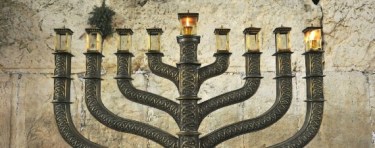
History records, during this time, a priest by the name of Mattathias, and his five sons, mounted a rebellion against Antiochus and his forces. They soon began to succeed in one battle after another, until they had taken back the city of Jerusalem, and restored worship within the Temple. It was at this time, the events that led to the celebration of Hanukkah took place. The story is told, when the temple was rededicated, they had only enough oil to light the lamp stand for one day, and it would take several days to prepare more oil. They lit the lamp and began preparing more oil. Eight days later, the oil was completed, and the lamp was miraculously still burning. Hanukkah, in many ways, is the celebration of the people of God doing great exploits.
We live in dark days, that seem to be getting darker. Personal freedoms are being lost in the name of tolerance, the rising threat of terrorism impacts almost every aspect of life, and immorality is on the rise, in what seems to be unprecedented levels. This is not the time for the child of God to cower in fear or lean on the arm of the flesh. These are times for “the people who know their God [to be] strong, and carry out great exploits.” These are times for us to live more committed to Christ, and to declare with an ever increasing boldness, the simple message of the Gospel. Times like these are the birthplace of heroes.
Pastor Jim
 As the prophecies of Ezekiel come to a close, he describes the allotments of land that will be given to each of the tribes of Israel. It is striking to me that seven times in the chapter theses districts are called “holy.” The inheritance the Lord gives to His people is always holy, and the life we live should be lived in holiness.
 Moab and Israel had a long and sorted history, dating back to Israel’s journey to Canaan. It was the king of Moab who hired the prophet Balaam to curse the people of God. Unable to curse those whom God had blessed, Balaam resorted to counseling Moab on how to put a stumbling block in the way of the people of God. They sent many of the young, attractive Moab women into the camp of Israel, with the purpose of luring the men into ungodly relationships and activity. This plan worked and many of the people of God fell into sin, and some even died for their misconduct. This animosity between the two nations continued, and almost a thousand years later, Ezekiel explains the reason Moab despised Israel. He writes
 Ezekiel points out that the sins of the parents resulted in the sacrifice of the children. When they stopped following the Lord, their decision impacted the next generation. I think it would do us good to keep in mind that we have a much greater influence on others than we might think. Jesus compared us to a city set on a hill that cannot be hidden (Matthew 5:14). Paul explained, the whole world is watching the Christian as though we were on display. When we decide to commit ourselves to the Lord, living to please to Him, that decision will impact others. People will take notice and decide to further their commitment to Christ. On the other hand, if we wander from the Lord, we will have a domino effect upon others who may fall along with us.
 A watchman bore the responsibility of keeping an eye on the horizon, in order to warn the inhabitants of the city of any possible threats to their safety. He would be strategically placed on the highest point of the city wall, where he would have the best vantage point to observe the surroundings. A watchman, who failed to do his job, might be responsible for countless lost lives. Ezekiel uses the role of the watchman to teach us something about evangelism. There are three things we need to keep in mind.
 Light is used to illustrate holiness. John is declaring that God is perfectly holy and without sin. This creates a problem, since we are all sinners. In this text, John explains how sinful people can have a relationship with a holy God. In the opening verses of the chapter, he refers to Christ becoming a man and making fellowship with God possible. That was accomplished through the cross, where Jesus died as a substitute for us. The sinless, in place of the sinner, so we might be saved. John is now writing to the one who recognizes his sin, and begins to follow Christ.
 The Christian life is like a journey. It begins when we put our trust in Christ for salvation, and ends as we cross the finish line entering into glory. In an age of high-speed travel, we often endure the journey for the sake of the destination. I have sat next to people on airplanes who were “white knuckling” the arm rests. I could tell they hate the idea of flying, but it was a necessity in order to reach their destination. The Christian life is not like that. The journey is as important as the destination. Walking, because it is such a slow means of travel, allowed for fellowship, life lessons, and teaching times to take place between Jesus and His disciples. He desires the same for us. As we go through life, we should see each day as a walk with the Lord. A walk in which we can commune with Him and learn from Him. Here in Ephesians Paul exhorts us on how to walk and what paths to take as we journey with Jesus toward glory.
 This verse carries two vital commands. First, we are told to examine ourselves, then we are told to test ourselves. Both carry the idea of looking at our lives in the light of the Word of God, to determine whether or not we are truly saved. Not all exams are of equal importance, but this is a test we must not avoid, or fail. What is at stake is not a low-grade in class, or the possibility of summer school, but where we will spend eternity.
 The Psalmist compares the way he looks to the Lord, to the way a servant looks to a master. If we are going to understand the comparison, we need to consider how a servant would look to a master. It seems to me, one word would describe it best. A servant looks to his master obediently. The role of the servant is to do the will of the master, and in order to do that, he must look to the master for instruction and respond with obedience. The servant does not have the right to argue with the master, nor the time to complain about how unfair his task, in light of what the other servants are doing. The servant obeys.
 Jim Gallagher