Numbers 33:52
“. . . then you shall drive out all the inhabitants of the land from before you, destroy all their engraved stones, destroy all their molded images, and demolish all their high places; . . .”
 God described the land He was giving Israel as a land that flowed with milk and honey. He was of course speaking figuratively of the blessed life that the children of Israel would experience within the land. This blessed life was conditional upon their obedience to Him, and their obedience included some driving out, and some demolition. They were instructed to tear down all of the images and the places where the false gods were worshipped. They were to leave nothing that would serve as a source of temptation. Moses went on to explain,
“. . . those whom you let remain shall be irritants in your eyes and thorns in your sides, and they shall harass you in the land where you dwell.”
Sadly, as the story unfolds, we will learn that Israel failed to drive out and demolish, and for centuries struggled with the temptation of the sins they allowed to remain in the land.
It is not difficult to draw a parallel between their experience and our lives. In order for us to experience the abundant life that Jesus offers, we also must do some driving out and some demolition. There are things that cannot remain in our lives if we are going to successfully walk with Christ. Those things include anyone or anything that will be an irritant, tempting us to sin and leading us away from the ways of God. Israe failed to obey this command partly due to the fact that they liked having some of those things around. They placed value on what God had banned and it was not long before they were caught in sin.
Stand back for a moment and examine the things in your life. Is there anything that needs to be removed? The way to do it is to go to the cross and lay it at the feet of Jesus, asking for His pardon, and strength to never pick it up again.
Pastor Jim
 Every generation likes to think of themselves as advanced beyond the previous generations. We look back on ancient civilizations and think of them as backward, and of ourselves as having progressed far beyond them in every way. This is particularly true of idolatry. We, in the western world, do not think of ourselves as idol worshippers, particularly, because we do not have carved images which we carry in our pockets or bow down to in prayer. The absence of an image is not, however, the only evidence of the lack of idolatry. An idol can be anything that takes the place of God in our lives. For many, even dedicated believers, it is common to put someone or something above the Lord and to pursue it more than God.
 Isaiah prophesied of a day when a nation would come against Judah, and the Lord would defend His people. This happened at the end of the 8th Century BC when the Assyrian forces besieged Jerusalem, and were supernaturally defeated. In light of this, Isaiah calls people to return to the Lord. I find it interesting, that he couples coming to the Lord, with the laying aside of idols.
 David paints a picture that is familiar to all of us. He is surrounded by those who are not following Jehovah, and are feverishly pursuing other things. The false gods of the heathen nations represented the pursuits of the flesh. They had gods of sexual passion, pride, possessions, power, intellect and more. David found himself surrounded by those who rejected God, pursued the flesh, and looked down upon him as he looked up to the Lord.
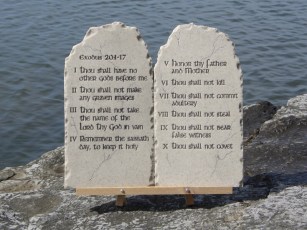 On the top of a mountain covered in smoke, Moses met with God, and heard the standard upon which relationship with God would be established. The Lord gives a list of ten commands that reveal His holiness, and our need for sacrifice. The first four commands reveal things about the nature of God. We learn, along with being jealous, just, merciful, faithful and holy, He is also the only true God and must not be reduced to an image or an idol.
 Jim Gallagher