Hebrews 1:3
“…and upholding all things by the word of His power…
 When the children of Israel were in the wilderness, God supernaturally provided for their needs. Each morning, as the dew settled on the ground, a substance known simply as “manna” would appear. Manna was similar to a pastry sweetened with honey, and contained all the nutritional needs of the children of Israel, throughout their wilderness journey. When the kids arose and were hungry, they were given manna, at lunch time, manna, after school snack, manna, dinner, manna. No matter what the hunger, the answer was “manna”. For those who lost site of the miraculous nature of this “Angel Food”, this may have become somewhat monotonous.
A similar thing often happens with believers. We face a fear, struggle, temptation, disappointment, challenge, or trial, and when we seek counsel, we are told to read the Bible. We might even be given a prescription of a couple of key verses, and told to memorize them, and meditate upon them. There are times when we may feel like “Come on man, I am in real trouble and need some real help, how is a Bible verse going to help me?”
“…and upholding all things by the word of His power…
Hebrews 1 describes the value of the Word of God and why, no matter what the diagnosis, the prescription is more of the Word. We are told the entire universe is held together by the Word of His power. I remember learning that within the nucleus of an atom, are two opposing charges that should repel one another but are being held together with what scientists refer to as “atomic glue.” Two thousand years ago, the Bible described the atomic glue holding all things together, as the Word of God.
The reason we prescribe the Word to be ingested daily, is because there is no substance in the universe which carries the kind of power that the Word of God does. It has the power to reveal to the sinner their need for a Savior, leading them to Christ. It has the power to transform the life of the struggling Christian, giving him strength to withstand temptation, and follow after Jesus. It has the power to equip the saint for service, providing him with a “sharp, two-edged sword” (Hebrews 4:12), with which to influence others for the kingdom of heaven.
Don’t get tired of the Word. Don’t think because you ate from it yesterday that you can skip your meal today. Like Manna, we must arise every morning and partake of the Word if we are going to benefit from its miraculous power.
Pastor Jim
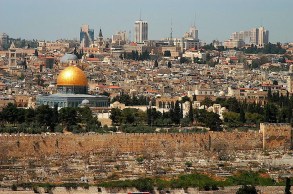 Isaiah promises a time when violence and destruction will be replaced with salvation and praise. Clearly, we have not yet entered that time. Violence is one of the major themes of our day. While this is true everywhere, it is especially true in the Middle East. It seems as though, not a day goes by where we are not faced with reports of violence, war, and terrorism.
 As Paul traveled the world to preach the Gospel, he had the great joy of seeing many come to Christ. Sadly, however, he also had the difficult experience of seeing some fall away from the Lord. Here he mentions two such individuals and describes their backsliding as being shipwrecked. They once had sails unfurled on course for the Kingdom, but had drifted off course and were no longer serving or following Christ. He mentions them as a warning to us of the dangers of falling away from Christ. A shipwreck is an appropriate analogy for the Christian because of the dangers we face on our journey towards what John Bunyan called “The Celestial City.” Unfortunately, shipwrecks, like backsliding, have a variety of causes.
 One of the primary themes of Paul’s letters to the Thessalonian church is the return of Jesus Christ. Paul lived with the expectation that Christ would return in his lifetime, and urged others to always be on guard. He had warned in his first letter that, “the day of the Lord so comes as a thief in the night” (1 Thessalonians 5:2). Looking around at the condition of the world they lived in, through the lens of Biblical prophecy, had caused some of them to be alarmed, and even gripped with fear. Paul mentions how they were shaken in mind and troubled. The term ‘shaken’ would describe a ship being tossed to and fro by the raging seas. The word ‘troubled’ carries the idea of crying out for help. Paul had written to a group of Christians facing turbulent times, with the purpose of encouraging them with the “blessed hope and glorious appearing of our great God and Savior Jesus Christ.” Yet the message designed to give them hope, had actually robbed them of peace, filled them with fear, and was causing them to cry out in despair.
 Judah was facing their darkest hour. Isaiah records that Sennacherib’ king of Assyria, came up against all the fortified cities of Judah and took them. One by one the cities of Judah fell to the all consuming Assyrian forces. Now that same army had surrounded the city of Jerusalem and threatened to take it by force. Before sending armed men, Sennacherib sent his chief of staff to warn the people of the folly of resisting. His rationale was that since other nations had trusted in their gods, resisted Assyria and fell to the sword, Israel would suffer the same fate if they trusted in the Lord. It is understandable that the unbeliever thinks all gods are the same, the problem arises when the child of God fails to realize that YHWH is above all others.
 Isaiah is speaking of something that only God can do. Even today, we face physical and natural difficulties that all of our human resources are unable to solve. Many who are bound by these things find that life is more like a barren wilderness than a running spring. Some have tried all sorts of techniques and programs only to find they are powerless to change. What we need is more of an encounter with the God, who can make lame men walk and bring water to a parched and arid land.
 There seems to be a great deal of teaching in the church today regarding prosperity. The messages vary, but the basic idea is God wants to bless and prosper you. This prosperity is defined as being wealthy, healthy and successful. There is no question, by following Jesus, you will avoid many of the pitfalls in life that lead to suffering, but it is wrong to use a secular dictionary to define Biblical terms. The same Jesus who promised abundant life, also promised that in this world we would have tribulation (John 16:33). The same apostle who experienced what it was to abound, also went through times where he was abased; he said, “Everywhere and in all things I have learned both to be full and to be hungry, both to abound and to suffer need” (Philippians 4:12).
 Isaiah takes us beyond his day to the future reign of Christ. In doing so, he promises a time when Egyptians, Israelites and Assyrians will follow the Lord and live in peace with one another. This might be referred to as the ultimate purpose of God, since He desires all men everywhere to be saved. If we look carefully at the church, and the commission we have received from Christ, we realize He wants ALL men EVERYWHERE to come to him for the free gift of eternal life. God designed the church to be assembled from people from every walk of life, and all people groups, who recognize Christ as Savior and follow Him as Lord.
 Isaiah paints a beautiful picture to illustrate salvation and its benefits. He writes it is like a well from which the waters of life can be drawn, and the child of God can be filled with joy. He goes on to say that we should declare this to all people.
 This is one of the most well known verses in Isaiah, and perhaps in the entire Bible. It is a verse which predicts the coming of the Messiah, seven hundred years before His birth. In this verse, we have a detailed description of the Savior of humanity. We are told a Child will be born, who is in fact, the Son of God.
 Jim Gallagher