1 Corinthians 9:23
“Now this I do for the gospel’s sake…”
 When writing to the Romans, Paul explained, the message of the Gospel has the power to save the sinner. It is when a person humbles himself and accepts that Jesus Christ died to do away with his sin, that he is saved. In order for a person to come to saving faith, he must hear the message and see the reality of it worked out in the life of the believer. Paul, understanding the importance of the Gospel, explains to the Corinthians the things he was willing to forgo, so others would hear about Christ and believe in Him.
First, he speaks of personal freedoms he was willing to lay aside. In his case, he chose to support himself rather than being supported by the church. Others had misrepresented the Lord by making Christian service look like a means of making a buck. To combat this, Paul made certain, while he was in Corinth, money was not the focus of the ministry.
Second, he speaks of becoming “all things to all men that I might by all means win some.” Paul is in no way suggesting that he is compromising the message of the Gospel, or his Christian witness. Instead, he is speaking of being relevant to those whom he is seeking to reach. One way Paul did this was by speaking to be understood. His goal, as a pastor, was not to use such eloquence as to show the world how brilliant he was, but to speak with such simplicity as to be sure the message was clearly understood. He was also careful not to do things that would turn others unnecessarily away from Christ. He saw the big picture. He understood that many of the views, and lifestyle choices people were involved in, were as a result of not knowing Jesus. Instead of making it his aim to change the behavior of the unbeliever, he sought to introduce them to Christ, who would transform their thinking and their living.
Third, Paul spoke of disciplining himself. He realized, one way to undo all his efforts in Corinth, was to personally get involved in sin, thus “blowing his witness.” To guard against this, he treated his Christian life the way an Olympian treats his body. Knowing that success only comes with training, diet and discipline, Paul was sure to have a healthy diet of time with Jesus, study of the Word, and Christian fellowship, while at the same time keeping unnecessary temptation out of his life.
Finally, Paul writes, “When I have preached to others…” The Gospel is seen when we live like Christ. However, it is primarily, hearing and not seeing the gospel, that leads others to faith in Christ. “Faith comes by hearing and hearing by the Word of God.” ( Romans 10:17) To ensure that others came to Christ, Paul opened his mouth and declared the simple message of salvation by grace through faith.
Paul wrote, all this was done for the sake of the Gospel. It would do us all good to ask, “What am I doing for the sake of the Gospel?”
Pastor Jim
 I can remember times, as a child, when I had to wake up very early for an event I was looking forward to. I would set my alarm, and a backup, then wake up over and over again through the night to check the time. I did not want to sleep in and miss out. I recall, one morning, hearing the alarm go off, getting out of bed, getting dressed and walking out to the living room, where I put on my shoes. After a few moments, I heard my mom’s voice asking me what I was doing. As I began to answer, I noticed all the lights were on and my parents were watching television. It was eleven p.m., I had only been asleep for about an hour, and had dreamt I heard the sound of my alarm clock.
 One of my favorite movie lines of all times is at the end of “The Princess Bride.” As the narrator comments upon the kiss of Wesley and Buttercup, he states, “Since the invention of the kiss, there have only been five kisses that were rated the most passionate, the most pure. This one left them all behind.” That statement, while nothing more than a poetic expression in the film, would certainly be true of the statement the Psalmist makes here.
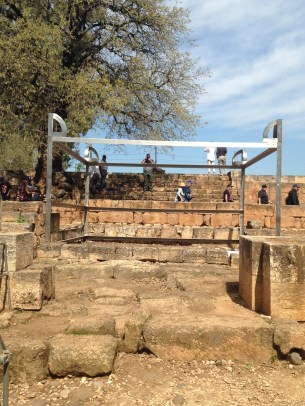 If a traveler from a distant land were to arrive in Israel during the reign of Ahab, there would be little to convince him that these were a people chosen by God. If he entered from the north, the first thing to catch his eye would have been a massive altar built on a high hill in the area of Dan. This altar was erected to give worship to a massive golden cow the people revered as their god. If he came from the south, he would see a similar site erected in Bethel. If he made his way into the heart of the nation, to the newly built city of Samaria, he would find the focal point of the city was an altar built to Baal, the god of fertility. If our traveler were to continue through the towns and villages of Israel, he would see a wide variety of altars and high places built to almost every imaginable god under the son. Essentially, Israel had deteriorated from a nation whose purpose was to glorify YHWH, and be a beacon of light to the world, to a nation just like their neighbors. They had all the same problems, and addressed them with all the same solutions, as those who had never met the Lord.
 Seven years, hundreds of thousands of man hours, and countless wealth, was invested in the building of the Temple. When it was completed, it was one of the most glorious buildings of the ancient world. The best architects, builders, artists, and specialist had been commissioned to accomplish a feat that still boggles the minds of historians today. One can only imagine what it must have been like to stand on the Temple mount, looking up at this glorious building, and looking down upon the city of David. Yet, with all it’s splendor, Solomon is struck with the realization, it is simply way too small.
 This Psalm is written as a result of David’s meditation upon what motivates people to sin. It seems to me, if we can understand what leads to sinning, we can avoid a lot of pitfalls. According to David, the number one reason for sinning, is “there is no fear of God.” To fear God means to be more concerned with pleasing God, than pleasing self or others. When a person puts God first in their life, and seeks to do what pleases Him, he will avoid much of what leads to sin.
 Balaam is an enigma. While he is clearly a false prophet who does great harm to the people of God, he is also responsible for some of the greatest Old Testament sermonettes. Here, he is taking a second look at the camp of Israel, attempting to find a way for Balak, king of Moab, to overthrow Israel. Instead, he learns how God sees His people.
 About 600 years after these events somebody got it into his head that it would be a great idea to take the Ark of the Covenant into battle. He had lost sight of who God was and thought the Ark of the Covenant was the presence of God. So, seizing the Ark, the army marched into battle, assuming it would ensure victory. They were defeated. The Philistines captured the Ark and took it into their camp. As a result, God began to plague the Philistines, so they put the Ark on a cart hitched to oxen, and sent the cart back to the nation of Israel where it remained in the house of Abinadab until the time of David.
 Israel needed to learn a very important lesson if they were going to be successful in walking with the Lord. That lesson: the Word of God is counter-cultural in every culture. They were being called to live by a different, and higher standard than the nation they came out of, and the one they were entering into. The same is true of the Christian today. It should not be shocking to us that the world has a different view of what is holy, acceptable, right or wrong, than we do. Instead of looking to the culture around us, we need to look into the Word of God to learn what is holy and what is sinful.
 One of the primary purposes of the book of Leviticus is to teach us that God is holy, and requires holiness from His people. The opening verse of Chapter 19 declares, “‘You shall be holy, for I the Lord your God am holy.” Holiness carries the idea of being set apart. Something that is holy, is something set apart for the Lord’s use. In the same way, someone who is holy has set themselves apart from anything that would defile them, so they might be fit for use by the Lord. As Moses explains the details of how to live a holy life, he speaks to the people regarding their fields and their garments.
 Jim Gallagher