Isaiah 44:10
“Who would form a god or mold an image that profits him nothing?”
 When archeologists discovered the remains of the ancient city of Jerusalem, which had been destroyed by the Babylonians, they discovered hundreds of small graven images or household gods. These images shed light on the fact that during the days Isaiah lived, idolatry ran rampant throughout the land. People filled their homes with images representing the gods they created with their own imaginations. Isaiah writes of the folly of idolatry. He describes a man planting a tree, waiting for it to grow, cutting it down, using a portion to build a fire to cook his meal, and the rest to shape into an image he will later bow down and worship. The gods that were created were the product of the imagination, and took the shape of the world in which they lived. The folly of idolatry is that we are both making god and worshipping god.
While our garages may not be factories producing idols, and our homes may not be filled with graven images, we are often guilty of the same actions which Isaiah described. We tend to allow our culture to affect our view of God, rather than our view of God to affect our culture. We trim things or add things to the God of Scripture, until He becomes a god we like. Sadly, when this happens, He is no longer the God of Scripture, nor is He capable of delivering us in time of trouble.
Rather than attempting to change God to fit our taste, we should be getting to know God as He describes Himself. The better we get to know Him, the more we will benefit when things in life become overwhelming.
Pastor Jim
 The Philistines mustered all their courage as they confronted Israel on the battlefield. They soon overpowered the Israeli army and took the spoils of war. In this battle, the spoils included the Ark of the Covenant. Upon returning to Ashdod, the Philistines placed the Ark in the their temple, and found themselves facing an interesting predicament; they now had two gods. As night fell, so did Dagon the Philistine god. When morning’s light appeared, they discovered the image of Dagon had fallen before the Ark of Jehovah. Their reaction was to help Dagon back to his feet. However, the next morning, they found Dagon had once again fallen, and this time, been destroyed. Realizing Jehovah would not share His position as God, the Philistines had a decision to make. Which God would they serve? Sadly, they rejected the true and living God and selected a man-made god.
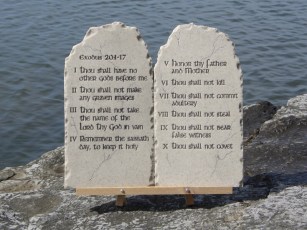 On the top of a mountain covered in smoke, Moses met with God, and heard the standard upon which relationship with God would be established. The Lord gives a list of ten commands that reveal His holiness, and our need for sacrifice. The first four commands reveal things about the nature of God. We learn, along with being jealous, just, merciful, faithful and holy, He is also the only true God and must not be reduced to an image or an idol.
 Later in Israel’s history, the Law of God will be imparted, and idolatry will be forbidden. One of the main reasons is, a manmade icon cannot adequately represent an infinite God. No matter how skilled the worker, or how beautiful the image, it will be a poor representation of God. The actions of Rachel reflect that idea, as she sits on her gods to hide them from her father. Any God small enough to fit in your pocket, is certainly too small to aid in time of need.
 Jim Gallagher