Isaiah 28:13
“But the word of the Lord was to them,
‘Precept upon precept, precept upon precept,
Line upon line, line upon line,
Here a little, there a little.’”
 I don’t know if it is “a guy thing”, but whenever my wife arrives home from grocery shopping and asks for help bringing the bags in from the car, I attempt to carry everything in at once. It may be the challenge or it may be out of laziness, but whatever motivates me, it is down right comical to see me laden down with groceries, attempting to open the front door. The fact is, there is a much better way to accomplish a big task, that is, one step at at time.
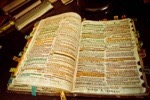
For many, the Bible seems like a massive undertaking. We look at it and have no idea where to start. Perhaps we have even attempted at times to become a student of Scripture, only to become discouraged by how little we understand. It is common to develop an attitude that we will leave the Bible for experts, then our devotional life becomes limited to reading books others have written about the Bible. Isaiah gives us a tip here on the proper approach to understwnding the Word of God.
“Line upon line, line upon line,
Here a little, there a little”
Many Christians attempt to read the Bible by randomly opening it and reading whatever text they happen to find. Can you imagine reading any other book that way? What if you read articles like that? Would you ever come to the authors intended understanding? The fact is, the best way to approach reading the Bible is to do so systematically. Since the Bible is a collection of books, the best place to start is in one of the four Gospel accounts. Read at least a chapter a day until you are finished, then select another and do the same. You will find that in no time you are beginning to learn and understand the Bible on your own.
Pastor Jim
 God established a worship schedule for Israel that included annual feasts, weekly Sabbaths, and daily sacrifices. It was important for the people to gather on Passover to celebrate, but it was not enough. It was necessary to meet on the Sabbath, but it was not enough. For them to carry on a healthy relationship with God, they needed to start the morning with offering and end the day with sacrifice.
 Paul and his companions were traveling throughout Greece. They had been in Philippi, Thessalonica, and would soon be in Athens. These were all very prominent cities. Philippi was the foremost city in the region of Macedonia, and Athens remained the scholastic capital of the Empire. Berea, on the other hand, was a small town, which in the large scale of things, was pretty insignificant. No one would be impressed with someone from Berea. They were not known for their universities, trade, or monuments.
 The Old Testament offerings served a duel purpose. First, they were designed to provide a way for man to have relationship with God. Second, they were designed as types or illustrations of a relationship between man and God through Christ. Paul wrote that these things were written for our “example” (Romans 15:4). An understanding of the Old Testament offerings, helps to illustrate the similarity of those offerings to a healthy relationship with Christ. The burnt offering is a picture of a life fully devoted to the Lord. This offering was brought to the priest morning and night, and completely consumed upon the altar.
 Jim Gallagher