1 Corinthians 3:1
“I, brethren, could not speak to you as to spiritual people but as to carnal, as to babes in Christ.”
 Paul mentions four types of people in the opening verses of this chapter. He refers to mere men (some versions read natural man), babes in Christ, carnal men, and finally spiritual men. These terms represent a natural development in the spiritual life of an individual. Natural man refers to a person before they place their faith in Christ. The natural man is living, breathing, walking, talking, perhaps even loving, giving, sharing and caring, but the natural man is separated from God, and living in sin. It is when the natural man hears the message of the cross, recognizes his need for a savior, and places his faith in Christ, that his sin is forgiven and he is born again into the family of God. At that point, he becomes a babe in Christ. Like all babies, the new Christian must be cared for. He needs constant companionship, encouragement, example, and a diet of the simple teachings of the Word of God.
Hebrews 6 gives a list of the foundational truths every young Christian must understand: “repentance from dead works and of faith toward God, the doctrine of baptisms, laying on of hands, the resurrection of the dead, and eternal judgment.”
When the young Christian ingests a healthy diet of the Word of God, he will begin to grow. Thoughts, words, and actions change, and many of the practices from the old life, are replaced with practices that are pleasing to God. Soon, the young believer is growing in Christ, and impacting others for the kingdom of God. They are no longer controlled by emotions, or by the influences of the world around them, but are now controlled by the Spirit of God. They begin to live a life that sets an example on earth, and stores up treasures in heaven. Paul refers to that individual as spiritual. Sadly however, this is not the route for every Christian. Some, after placing faith in Christ for salvation, never seem to grow out of infancy. Even years after coming to Christ, they are still struggling with the same doubts, fears and sins. Their Christian life is more like a swinging pendulum, than a walk with God. They “feel” close to Him at moments, and far away other times, they let the influences of the world influence them, and are constantly falling into sin. Sometimes, because of the guilt of constant failure, they seclude themselves from other Christians, and may even accuse the church of wrong doing. It is not uncommon to hear them use phrases like, “Christians are judgmental” to help justify the sins they have not outgrown.
Paul minces no words, he refers to that person as carnal, a word meaning worldly. While it is expected, and even cute, to see a baby act like a baby, it is sad to see someone still acting childish as a an adult. Now would be a good time to evaluate your walk with God. Are you growing? If you have been a Christian for only weeks, you should be seeking to surround yourself with godly influences and get to know the Word of God. If you have been a Christian for many years, you should see a dramatic and constant change in your life, because of the daily investment of the Word of God. The Christian life is a life of growth; like a tree, we only stop growing when we are dead.
Pastor Jim
Questions for 1 Corinthians 3
- Look up the word “carnal” and define it.
- How is the “carnal person” described by Paul?
- Paul speaks of planting, watering and increase; what part are you playing today in helping someone come to Christ?
- What foundation must we build our lives on? How are you doing that practically today?
- Paul speaks of our works being tested with fire. A day is coming where your Christian life will be judged by God. What are you doing for the kingdom of Heaven?
- How is God’s wisdom contrasted with human wisdom?
Old Testament:
Esther 1- Love And Respect
Esther 2- Chosen
 The things God has planned for each of us are better than anything we could ever imagine. Rather than leaving us to our imagination, Paul declares these things are revealed to us by the Spirit of God. It is the desire of God that we know Him, and we understand the things He has planned for each of us.
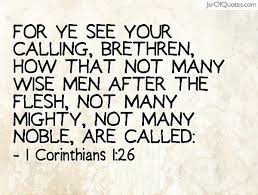 Paul reminded Timothy that Jesus Christ came into the world to save sinners. That was His purpose, His passion, and what He labored diligently towards. After the resurrection, Jesus called His church to be involved in this same purpose. He commissioned men to “Go into all the world and preach the Gospel.” This is the greatest of all vocations and carries with it the highest honor. Charles Spurgeon once wrote, “If God has called you to preach do not stoop along the way to become a king.”
 Years ago, I received a letter; I had been selected to be awarded for my accomplishments as a teacher. Upon reading the first paragraph, I was honored and somewhat humbled. My ego was stroked, as I was being told of the great responsibility I was fulfilling by teaching others. However, as I continued to read, I discovered any teacher who was willing to purchase the hundred-dollar, leather-bound book, would have their name listed in it. Even though I knew it was a scam, I was still slightly tempted to have my name in a book honoring me for my accomplishments.
 This chapter contains many prayers of which this is the first. Paul is praying that the church might be like-minded, or rather, have one mind. As we look at the church today we see it is anything but one-minded. Worship styles vary from rock bands to congregational hymns; some churches meet in traditional buildings, while others meet in schools, parks or store fronts. Doctrinally, some churches are Calvinistic, Arminian, or somewhere in between. We have pre-, post- and mid-tribulation teachings, and there are even different views on how to perform a baptism.
 A Christian by the name of John Donne (1572-1631), is credited for the saying, “No man is an island.” He wrote it in a devotional message speaking of how our lives affect one another. Paul is writing about the same idea, because we are part of the body of Christ, our lives effect one another. The decision I make to follow the Lord will have an impact upon those around me, and their decision will impact me. In more recent times, a song was written with the chorus, “I don’t need anyone, I am really having fun being all alone, I am an island.” The song was a parody, where the artist was addressing the modern idea that our lives are our own, and our sins do not effect anyone else. Paul goes on to write,
 I can remember times, as a child, when I had to wake up very early for an event I was looking forward to. I would set my alarm, and a backup, then wake up over and over again through the night to check the time. I did not want to sleep in and miss out. I recall, one morning, hearing the alarm go off, getting out of bed, getting dressed and walking out to the living room, where I put on my shoes. After a few moments, I heard my mom’s voice asking me what I was doing. As I began to answer, I noticed all the lights were on and my parents were watching television. It was eleven p.m., I had only been asleep for about an hour, and had dreamt I heard the sound of my alarm clock.
 Over the years, I have found most of us are trying to determine God’s will for our lives. We have come to understand, His ways are better than our ways and if we desire abundant life, we want to be in the center of His will. Most of us have heard the story of Jonah, a man who refused to go where God wanted him and was consequently swallowed by a large fish. I do not want to spend any time in the belly of the beast, and would much rather go where God wants, and do what God wants. Part of His will can be difficult to decipher and is only determined by following the example of Mary, sitting at His feet. If you are trying to decide what job to take, who to marry, or if you should have another child, the best thing to do is spend time with Jesus.
 Paul is referring to one of the most difficult times in the life of the prophet Elijah. He lived during a time when the nation of Israel had turned from the Lord and had become steeped in idolatry. As the people stood in the valley of decision, swaying between a decision to follow Jehovah or become more like the world around them, Elijah stood boldly for the Lord and saw the beginnings of a national revival. This did not come without a price. Jezebel, the queen who was openly opposed to the ways of God, began a campaign to see Elijah killed. These were not idle threats, for she had been responsible for the death of many of the prophets of God. Elijah saw no other course of action except to flee. He ran from Mount Carmel in the north of Israel, all the way to the wilderness where Moses had received the Law of God. There, in a place of solitude, he began to cry out to God. “I alone am left of the prophets of God and they seek to take my life.” He truly believed that his life was over and there was no escape from certain death. His fears led his heart to speak, but in the midst of his trial, he heard another voice saying,