Exodus 20:4
“You shall not make for yourself a carved image—any likeness of anything that is in heaven above, or that is in the earth beneath, or that is in the water under the earth;”
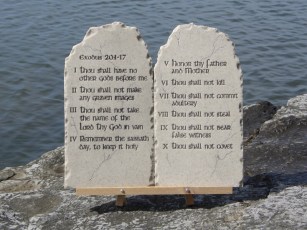 On the top of a mountain covered in smoke, Moses met with God, and heard the standard upon which relationship with God would be established. The Lord gives a list of ten commands that reveal His holiness, and our need for sacrifice. The first four commands reveal things about the nature of God. We learn, along with being jealous, just, merciful, faithful and holy, He is also the only true God and must not be reduced to an image or an idol.
Icons or religious artifacts are a part of every religious system. People cling to man-made objects thinking they are closer to God if they kiss an image, wear a necklace, or carry a religious charm. God makes it clear, this has no place in relationship with Him. It seems to me there are two primary reasons for this.
First, no image can adequately represent God. If we try to make something that shows His love, He often looks weak. If we try to replicate His power, it makes Him looks tyrannical. If we showcase His mercy, we neglect to reveal His justice and holiness. There is no earthly image that can reveal the majesty of His divine nature. That does not mean we cannot know God. In fact, Paul wrote,
Colossians 1:15
“He is the image of the invisible God, the firstborn over all creation.”
The person of God will never be adequately revealed in a poster, icon or artifact. However, we can see deeply into the nature of God by examining the words and ways of His only begotten Son.
Second, images not only fail to represent God, they also give a false sense of his presence. When we cling to an icon as a reflection of God, we lose sight of the fact that He is ever near His children, and wants us to cry out to Him. We must learn not to look to an image, but beyond the image to the very throne of God, where Jesus sits ready to pour out His grace, mercy, love and power, to help us walk with God.
Pastor Jim
 I imagine if any of the people in this massive caravan were asked where they were headed, they all would have given the same answer, “We are going to the Promised Land.” They had grown up with stories of a land flowing with milk and honey; had been dreaming of this day for generations. Their goal was to reach a land where they were free from the tyranny of Egypt. At the same time, if we were able to look up and ask the Lord where this multitude of people was headed, His answer would not be the same. To Him the destination was somewhere entirely different. God said “I am bringing them to myself.”
 The phrase “He could do no mighty work there…” has always fascinated me. Think about it. The one who healed the sick, calmed the seas, rebuked the demons, raised the dead, created all things, and by the word of His power, holds all things together, could do no mighty work there. Why? What is it that kept the mighty God from accomplishing His mighty works.
 When the sojourning camp of Israel reached Rephidim, they were horrified to discover there was no water. There are many things in life we view as necessities, which are actually comforts; water is not one of them. A person can survive in difficult desert conditions for about three days without water. Their situation was grave, to say the least. This truly could have been the end for Israel. As the people assessed the problem, the only solution they could come up with was to return to Egypt. They knew if water was not discovered quickly, they would certainly perish.
 Mark 4 ends with the story of a dangerous journey on which Jesus took His disciples. Knowing all things, He knew they would face a storm on the sea. He knew this storm would be so great that those who had grown up fishing those waters, and experiencing rough conditions, would fear for their very lives. But it is not until we venture into Mark 5, that we understand the reason for the journey was one man. Jesus left the multitudes and took twelve men on a death-defying trip across dangerous waters, in order to reach this one man. Multitudes were flocking to Him, but in the country of the Gadarenes, was a man in need. This becomes even more amazing when we understand who this man was. We read of him,
 Have you ever heard the proverb, “curiosity killed the cat?” It speaks to that part of our nature that wants to look into things that we shouldn’t. Not all curiosity is bad, in fact it can often lead to some pretty amazing opportunities. However, when our curiosity leads us to disobey the clear commands of God, that will always lead to danger.
 Paul wrote in1 Corinthians 2:14,
 There can be little question that the children of Israel were following the leading of the Lord. They had a miraculous door open; freeing them from slavery. They began to march, carrying gifts from Egypt, and being led by a pillar fire and a cloud. What was hard for them to understand was, the Lord had led them into a very difficult place. With Baal Zephon on one side, Migdol on the other, and the Red Sea before them, Israel was boxed in, with no where to turn. As the Egyptian army approached, the Israelites were the proverbial sitting ducks. With fear gripping their hearts, they cried out to Moses, declaring life was better in slavery than in the wilderness. It was with this backdrop, Moses gave one of the most beautiful promises of God.
 Jim Gallagher