Acts 28:6
” However, they were expecting that he would swell up or suddenly fall down dead. But after they had looked for a long time and saw no harm come to him, they changed their minds and said that he was a god.”
 After the ship ran aground and all the passengers and crew arrived safely on shore, it would not take long for the onlookers to see who was who. Even after saving the lives of the entire crew, Paul is still treated as a criminal, and is sent to gather sticks for the fire. While reaching for a stick, Paul encounters what many people fear the most… a snake.
I have seen grown men scream like little girls, push their friends out of the way, and even leave friends stranded in the dark, at the sight of a snake. Paul did not just see a snake, but it struck him and refused to let go. What a sight that must have been! The darkness illuminated by the fire’s flames, and in the shadows, Paul swinging his arms around, attempting to get this poisonous viper to release its grip. The natives of the island, seeing this scene, determined that Paul must be a guilty man; although he was able to escape the sea, the viper got him. As they looked on, expecting him to be killed, their opinion drastically changed. They began to think that he was not a guilty man or even a man at all, but that he must be a god, for only a god could survive such things. What would cause them to have such a drastic swing in their opinion of Paul? I think it was due to their lack of a spiritual foundation upon which to build their understanding of God.
While we probably are not often mistaken for gods, we certainly live in a time when people seem to have little or no spiritual foundation. Outside the church, we find people searching everywhere to find spiritual encounters. Just the other day, I saw signs around our town for a “Psychic Seminar,” where people could come and have a spiritual experience. Within the church, emotions and experience are often mistaken for the moving of the Spirit; and popular opinion shapes our view of the love and holiness of God. We live in a time when a firm spiritual foundation is essential to develop our understanding of God; and that foundation can be nothing less than the Word of God.
Rather than being tossed around, wondering what God is really like, we need to take the time to see who He declares Himself to be, within the pages of His Word. It is very common to hear people say, “We can’t limit God” or “You cannot put God in a box.” While it is true that we often limit God and miss out on what He wants to do in and through us, it is also true that God has put boundaries upon Himself. Those boundaries are found in the pages of His Word. God is not different from who He declares Himself to be, nor will He change His viewpoint based upon public opinion. Let’s determine today to get to know the God of Scripture, rather than the god of culture.
Pastor Jim
 After appealing to Caesar, Paul was sent on the long journey to Rome. He was to stand trial for the accusations brought against him by the religious leaders of Jerusalem. Paul was released from his Caesarean prison and placed in the care of Julius, a Roman centurion. Acts 27-28 records the story of their journey to Rome. Right away, this journey faced obstacles.
 It has been said, if we can believe the first four words of the Bible, we should have no problem with the rest of its claims. “In the beginning God…” The Bible is filled with stories of the mighty workings of God. We read of Him speaking the worlds into existence, delivering a nation from the threat of death, parting the seas, providing food in a desert, knocking down the walls of Jericho, raising a shepherd boy to the palace, healing the sick, and delivering those who were possessed by devils. Page after page, we read of God being God and providing victory over the affairs of life. It seems that for many of us, we have no problem believing in the mighty workings of God. We trust the validity of our Bibles, we celebrate His mighty work in the life of others, and even sing together of His miraculous power. However, when it comes to our own lives, we sometimes act like Agrippa. We question the ability of God; we wonder if His power is really strong enough to help us in our time of need.
 Jesus instructed His followers that their lives are to be lived as a testimony to the world. He taught “Let your light so shine before men, that they may see your good works and glorify your Father in heaven” (Matthew 5:16). In other words, the way we live should testify of a living God.
 Time is an interesting thing. We are always spending it and it cannot be saved. Failing to do something today, does not guarantee we will have the time for it tomorrow. Felix’s encounter with the Gospel message teaches us something important about how we use this moment for eternal things.
 Webster defines a trial as, “A test of faith through subjection to suffering or temptation.” Paul’s current situation may be the text book case of a trial. He came to Jerusalem with the goal of sharing Christ with his friends and countrymen, spent his time preparing to share with them, but before he ever spoke a word, he found himself under attack. After his unjust arrest, he had two opportunities to share the Gospel; both times he was cut short, as the people become enraged with him. To make matters worse, his Christian friends had warned him not to go to Jerusalem in the first place. They said he would be beaten, arrested and perhaps killed. Paul believed the trip was the Lord and ignored their warnings. Now, incarcerated and facing the threat of death, it would be natural to feel as though he had failed the Lord and his situation was hopeless.
 After his arrest, Paul shared Christ with the mob that tried to kill him. They listened intently to him because his message was fascinating and relevant. It seemed they had a true interest, and even an openness to the Gospel. But that all changed once Paul mentioned the Gentiles. That single word caused the hearers to close their ears, harden their hearts, and reject the message of Christ.
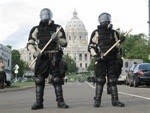 The scene in Acts 21 might best be described as a riot. The people of the city had lost all sense of the Temple worship, and had become a violent mob determined to put Paul to death. Their rage escalated to the point where the Roman soldiers had to almost beat them back, in order to pull Paul out of their clutches. We read, when they reached the stairs (the way of escape) Paul could no longer walk on his own, but had to be carried by the soldiers. It seems that even after the arrival of the soldiers, the crowd was still taking shots at Paul.
 When reading the Bible, we should always look for application to our personal lives. In some texts, the truths to apply are very straight forward, others, are a little more difficult to find. This passage tells the story of a young man, Eutychus by name, who nods off during a Bible study and ends up dead. I think the passage is a warning of more than the need to stay awake at church. Eutychus’ fall is a perfect illustration of the way sin works.
 Ephesus was a very large city with a diverse population. It is estimated, at the time of Paul’s visit, there may have been in excess of 400,000 people living in the city. Ephesus was the largest city in Asia Minor, and one of the largest in the empire. Because of its location, on a trade route, the city was very wealthy; it had become an important center for commerce. Like any large wealthy city, Ephesus had its share of vice. One of the greatest was temple prostitution. Overlooking the city, was the Temple to Diana; which was an awe-inspiring site. It drew pilgrims from all over the world to come and worship. The worship practice included sexual immorality.
 Jim Gallagher