Psalm 126:5-6
“Those who sow in tears shall reap in joy. He who continually goes forth weeping, bearing seed for sowing, shall doubtless come again with rejoicing, bringing his sheaves with him.”
 Genesis, Chapter 1, describes the creation of the universe. We read the earth was without form and void until God spoke, and all things were brought into being. There is a clear contrast between the chaotic state of things before God spoke, and the orderly universe that He designed. Ever since that day, man has been discovering laws that govern the physical world. These laws were designed by God to keep order, and we have learned to trust in them . I believe it was Sir Isaac Newton who was attributed with the quote, “What goes up must come down” in response to his findings about gravity.
Here, the Psalmist speaks of another basic law of nature, the law of sowing and reaping. Scientific laws are formulated by observation and experimentation. The law of sowing and reaping is a principle that is discovered, not in the lab with test tubes, but on the field by farmers. For centuries men have cleared the ground, tilled the soil, planted seeds and awaited the harvest. For centuries men have not been surprised by what they gathered in. If the farmer planted corn seed, he harvested corn, if he planted millet, he harvested millet.
Over and over again, this basic law has been proven throughout the history of mankind. It is the Word of God that brings this same principle out of the natural world and into the spiritual one. When writing to the Galatian believers, Paul declared, “Do not be deceived, God is not mocked; for whatever a man sows, that he will also reap. For he who sows to his flesh will of the flesh reap corruption, but he who sows to the Spirit will of the Spirit reap everlasting life” (Galatians 6:7-8). What is true in the natural world, is also true in the spiritual one. Whatever seed we put in, is the fruit that will come out. If we sow into our lives things that will tantalize the desires of the flesh, we will find that the battle against the flesh will be too great for us to withstand. If we sow into our lives, the building blocks of a healthy relationship with Christ, i.e. daily reading of the Word, prayer, Christian fellowship and service, we will find we are reaping a strong, and vibrant relationship with Christ.
Paul added one more element to the law of sowing and reaping when he declared in Galatians 6:9, “And let us not grow weary while doing good, for in due season we shall reap if we do not lose heart.” It is this basic idea that the Psalmist is referring to here. We live in a world where things come to us instantly.
When we are hungry, we take pre-cooked meals, microwave them, and within minutes we are eating. When we want to find the answer to a question, we grab our smart phone, Google it, and within seconds have more answers than we could ever read. In fact, if our device takes more than a few seconds to load, we complain about how slow the connection is, and begin to covet a newer, faster model. We must realize, there are some things that take time. Some things are governed by the law of sowing and reaping. They may take consistent sowing, over a long period of time, before we ever see the desired results.
Personal righteousness, victory over easily besetting sin, and winning loved ones to Christ, are things that often require long periods of faithful sowing. Instead of losing heart, we ought to rejoice in the promise given here,
“Those who sow in tears Shall reap in joy. He who continually goes forth weeping, bearing seed for sowing, shall doubtless come again with rejoicing, bringing his sheaves with him.”
Pastor Jim
Questions for Psalm 126
- In verse 1 and 2 the psalmist writes about a time when God rescued Israel from captivity. He tells of the great joy that came from God’s deliverance. When have you been in “captivity”? Have you experienced God freeing you from captivity? Read John 8:36. Where does our ultimate freedom from captivity come from?
- Note verse 2. When people see God’s liberating work in the life of others, how do they respond?
- Note verse 3. When we become aware of the great things that God has done for us, how do we feel?
- Read verse 5-6. What is the result of faithfulness to God through difficult times?Psalm 126
- In verse 1 and 2 the psalmist writes about a time when God rescued Israel from captivity. He tells of the great joy that came from God’s deliverance. When have you been in “captivity”? Have you experienced God freeing you from captivity? Read John 8:36. Where does our ultimate freedom from captivity come from?
- Note verse 2. When people see God’s liberating work in the life of others, how do they respond?
- Note verse 3. When we become aware of the great things that God has done for us, how do we feel?
- Read verse 5-6. What is the result of faithfulness to God through difficult times?
 The Psalmist compares the way he looks to the Lord, to the way a servant looks to a master. If we are going to understand the comparison, we need to consider how a servant would look to a master. It seems to me, one word would describe it best. A servant looks to his master obediently. The role of the servant is to do the will of the master, and in order to do that, he must look to the master for instruction and respond with obedience. The servant does not have the right to argue with the master, nor the time to complain about how unfair his task, in light of what the other servants are doing. The servant obeys.
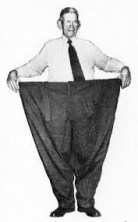 I have always been somewhat puzzled by the marketing slogan “one size fits all.” It seems that really means it might fit, but it won’t fit well. It is much like the all-in-one tools that don’t seem to do any jobs quite right.
 As David recounts those who would serve in the various capacities within the house of the Lord, he reminds us that all service, small or great, is determined by the Lord. Those who would attend to the gates of the city were chosen by lot. A person given charge over a lesser gate, needed to serve with the same faithfulness as one who served at a larger gate. This is a key principle in ministry. Jesus put it like this,
 Webster’s dictionary defines a chronicle as “a historical account of events arranged in order of time without analysis or interpretation.” The main purpose of 1Chronicles is to give an historical record of the nation of Judah. This chapter focusses on the descendants of Aaron, the priest. While it may seem less than devotional to read a list of names, I think it is worth noting, that a system based on heritage would require a huge emphasis upon raising the next generation to follow the Lord. If Israel was going to remain as the people of God, then the priests would have to raise their children to love, trust, and obey the Word of God and the God of the Word.
 The writer of Hebrews exhorts us not to forsake the gathering together of the brethren (Hebrews 10:25). In other words; get to church! That is the heart of what David is singing about in this Psalm. He begins by declaring what a blessing it is to have someone invite him to the house of the Lord. Even as the king of a nation, David was still a man, and as a man, it would be wonderful to receive an invitation from someone to attend worship.
 Life is filled with trying experiences. We are often faced with difficulties we would not wish on our enemies, or with circumstances we would love to change. These experiences can shake us at the core of who we are and cause us to look outside of ourselves for assistance. We can learn a vital lesson from the Psalmist, who, in the midst of his difficulty, chose not to look out to his friends, or back to his old ways, or around at what others might be doing, but instead, he chose to look up to the only One who could truly assist him in his time of need.
 When it comes to worship, we can learn much from King David. The longest book in the Bible is a book of praise songs, and David was its largest contributor. In addition to being a king and a prophet, he was also called the Sweet Psalmist of Israel. In our text, we find David bringing an offering to the Lord. Because of his position as king, Ornan offered him the field and the animals free of charge. Instead of accepting the gift, David made a statement that should become a foundational principle in our worship, “I will not offer that which cost me nothing.”
 The devil is crafty and a master of deception. Paul referred to him as an angel of light, because of his ability to disguise himself in order to fool the Christian.
