Psalm 63:1-2
“O God, You are my God; early will I seek You; my soul thirsts for You; my flesh longs for You In a dry and thirsty land where there is no water. So I have looked for You in the sanctuary, to see Your power and Your glory.”
 Have you ever had one of those times when you are craving something, but you are not sure what it is? When that happens to me I tend to keep trying things, in an attempt to satisfy a craving that I cannot define. What is true with physical hunger, is also true in the spiritual realm. God created us with a need for Him. This need evidences itself with a desire to find meaning in life, answers to what lies beyond this life, and a craving to worship.
Man is incurably religious due to his built-in hunger to know God. This hunger to know God is sometimes clouded by the sinful world in which we live, and by personal experiences. Many, knowing an emptiness within, fail to recognize that it is a spiritual craving to know God. They attempt to satisfy it with relationships, substances, or experiences. Often, these very attempts to satisfy the cravings within, become addictions or leave us scarred. Instead of satisfying our need for God, they fill the spiritual hole within us with junk, which may take a lifetime to get out.
After meeting God, David went on to declare that his soul was satisfied. Meeting God does that. Once you have come to God through Christ, you no longer need to hunt around for spiritual satisfaction, you are satisfied. However, if you have truly met Him, you develop a new hunger. This is a hunger that keeps you coming to Him for more.
David did not write this Psalm as an unbeliever who just met the Lord, but as a godly man desiring to know God better. David gives insight to properly fulfilling our built-in hunger for God. He says, “So I have looked for You in the sanctuary.” While it is true that God is everywhere, and we cannot hide from Him, it is also true, there are places where we will have a greater chance of meeting with Him, and hearing from Him. It is much easier to hear, when we gather with the people of God in corporate worship. David, knowing his hunger was for God, made his way to the sanctuary, where he was sure to meet with God.
Pastor Jim
Old Testament:
1 Kings 9- If…Then…
1 Kings 10- What Does It Mean?
 We cannot be certain of the occasion that stirred David to write this psalm. It may have been a time of great difficulty, opposition or trial. He may have been facing severe attacks from Saul, the Philistines or one of the neighboring kingdoms. It is also possible the struggles he faced were not external. It may have been that David was engaged in that great inner struggle between his desire to do what is right in the eyes of God, and his own human weaknesses. Whatever caused the dilemma, he concluded that the only solution was to cry out to the Lord. Crying out to God should include at least three things.
 In the early eighties, a well-known Christian band wrote a song called “God Rules.” In some ways, it became the anthem of many young Christians. I remember having a “God Rules” bumper sticker on my car, and proudly writing it on my school notebook. To me, that phrase was a slang term meaning little more than the fact God was best. I believe the Psalmist is saying much more than that, he is speaking of the sovereignty of God. The word sovereign means ‘to possess supreme power.’ David is declaring that God has supreme power over His people.
 This has to be one of the most striking prayers ever recorded. David is looking at the behavior of those who have cast aside the ways of God and his heart cries out for justice. While it may seem harsh to ask God to break someone’s teeth there is an important principle that is vividly illustrated in David’s song. The principle is that there are certain things that should fill us with rage and produce in us a desire for righteousness.
 David was facing an extremely difficult season in life. The more things began to unfold the more he desired to run away and hide. He writes of his desire to flee to the wilderness far away from the problems and the people that surrounded him. He writes of desiring to have wings that could carry him far from his problems. I don’t think the psalmist is alone in this. I know I have felt this way and have met many believers who long for a way to escape the difficulties of life. I wonder how many of us have wished for our own private get away far from the problems and issues of life? While there is no island or mountain hideaway where we can be saved from the issues of life, there is a place the child of God can run for refuge.
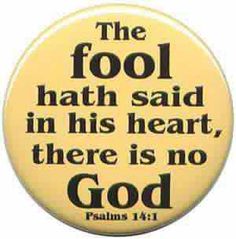 Biblically speaking atheism is considered folly because God has gone to great lengths to reveal himself to mankind. Paul, when writing to the Roman church divided God’s revelation of himself into two categories; he spoke of things being manifested “to us and in us.”
 David makes reference to the fact that he was born into sin. He realizes that his sin is not just a mistake that he made but a consequence of his very nature. The bible teaches that sin was passed down to us from Adam and has affected all of us making all of us sinners. Reforms are good and necessary both individually and nationally but these reforms cannot change our nature. We can become better husbands, fathers, neighbors and citizens but until we are born again we still have a nature that is unredeemed and we will be forbidden access to heaven.
 Have you ever heard the phrase “You can’t take it with you”? It seems like this sentiment might be as old as time itself. Thousands of years ago the sons of Korah used it as a lyric in one of their most famous songs. The basic thought is that when this life comes to an end all that we have accomplished will be left behind. In recent years I heard a similar phrase that carries the same thought, “You never see a hearse pulling a U-Haul trailer.”
 Sometimes knowing the setting in which a psalm was written is beneficial to understanding its content. Other times, like in this psalm, the setting is not given because the truth is universal. Whatever our condition, whether we would classify it as good or bad, blessing or trial, God remains the same and is always worthy of the highest praise. The truths tucked away in this psalm transcend every experience the child of God endures. Whatever state you are currently facing, it is a good idea to clap your hands and shout out the loudest praise.


