Ephesians 1:16
“I do not cease to give thanks for you, making mention of you in my prayers . . .”
 Prayer is the place where we express our greatest desires. It is at the Throne of Grace our hearts pour out their deepest cries to God. Paul spoke to the Romans about those times when our hearts cry is so great, it is manifested with “groaning’s that cannot be uttered” (Romans 8:26). Here we find the Apostle crying out in prayer for the saints and we learn what his greatest desires are for the Christian. His prayer consists of four requests.
“May God give to you the spirit of wisdom and revelation in the knowledge of Him . . .”
Jesus defined eternal life as “knowing God”. It is when we receive Jesus Christ as Savior and Lord, that we begin a relationship with God. Paul’s plea is for us to know Him better. The knowledge that He is speaking of is not the knowledge of information, but of relationship. He wasn’t praying for us to simply know more facts about God, but that we would experience more of God. This is something that will happen as, daily, we spend time with God, in the pages of His Word, and apply the things we read to our daily living.
“That you may know what is the hope of His calling . . .”
Next Paul prayed that having begun to know God better, we would get to know His calling on our lives. Discovering the will of God for our lives is a daily adventure, but can be guided by understanding some general principles about the call of God. According to Scripture, we have been called out of the world. That does not mean that as Christians we are to isolate ourselves from anyone who is not a believer, but we are to separate ourselves from the behaviors we practiced before coming to Christ. We have also been called to holiness. Holiness could be defined as living in a way that is well pleasing to the Lord. As a Christian, our first goal with every decision we make, or activity we are involved in, should be to please God. We have also been called to service. As a Christian, we are part of the growing Kingdom of God, and should be actively participating in seeking to win others to Christ.
“What are the riches of the glory of His inheritance in the saints . . .”
The word inheritance speaks of something that is received. When a person dies, they often leave a will which distributes their goods as they wish. Because of the death of Jesus, all who trust in Him for salvation receive eternal life as an inheritance. It is a free gift given in response to simple faith. That being said, notice Paul is not praying regarding our inheritance but His. What is the inheritance Jesus received as a result of going to the cross? Simply put, His inheritance is you. Hebrews 12 tells us it was the joy of receiving you as an inheritance that motivated Him to endure the suffering and shame of the cross. Think about that. Jesus considers us to be a rich and glorious inheritance, worthy of all the suffering He was forced to endure at Calvary. One of the most important things we must settle, if we are going to follow Jesus, is that He loves us and wants to do great things in and through us.
“What is the exceeding greatness of His power toward us who believe . . .”
Finally, Paul prays regarding the exceeding, great power of God. This power is more than sufficient for any obstacle in its way. That is not true of my power. There are many things I cannot lift, push, climb over, under or around, but the power of God is more than able. Perhaps the most encouraging thing Paul says about the power of God is that it is “toward us.” In other words, when we decide to follow Jesus, the exceeding, great power of God is now on our side, enabling us to walk with Him and serve Him. There are so many obstacles that seem to impede our walk with God. We face the difficulties of our own flesh, as well as the fears connected with any task into which He leads us. We can be encouraged by the fact that whatever He calls us to, He has the power to accomplish. As always, we cannot focus on our weaknesses, but must fix our eyes upon His strength.
Let’s pray these same things for ourselves and for one another.
Pastor Jim
Old Testament:
Song Of Songs 3- The Honeymoon Experience
Song Of Songs 4- My Love
 Galatia was located northwest of Syria. It was a region consisting of such places as Tarsus, Iconium, Lystra and Derbe. It was the location of Paul’s first missionary journey. As Paul and Barnabas traveled throughout Galatia preaching the Gospel, many trusted in Christ and churches were birthed. While nothing matches the thrill of seeing someone come to Christ, the preaching in Galatia came at a very high price. It was there, Paul was beaten and left for dead. Some suggest, the vision problems that plagued him, were a result of the severe beating he endured at the hands of those who rejected Christ. This persecution was initiated by the Jewish people who refused to accept that Jesus was the Christ. After Paul and Barnabas departed, these young Galatian converts were left to endure this hostility. They would be ridiculed, bullied, harassed, threatened and more, all because they were living in a way that was not deemed culturally acceptable.
 Paul is reminding the Galatians that many of the behaviors and activities they were involved in, before coming to Christ, are no longer fitting. Before accepting Christ, much of our existence is spent trying to find the meaning of life, or at least some semblance of meaning. We realize something is missing, and continually search for it. We may party for while, thinking that will make us happy, or get involved in a relationship or multiple relationships, all in pursuit of filling a void or adding something to life. Some are able to realize the inability of these cravings to satisfy, and move on to something else. However, many become addicted and find themselves in bondage to the very pursuits that falsely promised freedom. Whatever your story is, you will not find life’s missing puzzle piece until you come to Christ. It is in Christ that we are made complete. “. . .and you are complete in Him, . . .” Colossians 2 :10
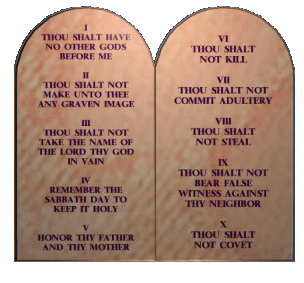 The law Paul refers to is what is commonly known as the Ten Commandments. This law is distinct from all other laws in its source and in its purpose. We are surrounded by laws written by men and designed to be kept. The Law of God was written by the hand of God; its purpose, to reveal that we are incapable of living up to His standard of righteousness. When confronted with the Gospel, many will claim they are good people, trying to honor God by keeping the commandments. Anyone who makes that statement, completely misunderstands the commands of God. Let’s take a look at a few of them and see how we measure up.
 Many different metaphors are used in the Bible to describe what happens when a person receives Jesus Christ. We are born again, adopted, redeemed, forgiven, made alive, and much more. Each of these is designed to reveal different aspects of salvation. Being born again speaks of our new lease on life, being forgiven asserts that nothing from our past will ever be held against us, and being made alive points out the fact that salvation is a supernatural work of God, which cannot take place without the Holy Spirit.
 We spend a lot of time, effort, and energy, seeking to determine the will of God for our lives. Right now, many of us are facing circumstances where we are not exactly sure what God wants us to do. Should I go ahead with Plan A or is it time to implement Plan B? Should I take the new job, or wait this one out a little longer? Should we let the kids do this, or is it best to wait till they are a little older? Needless to say, we are plagued with questions that we need the will of God to answer. While this text does not address those questions specifically, it does give us some keen insight into the will of God for our lives. Paul associates the will of God to the giving of His Son and delivering us from evil.
 This verse carries two vital commands. First, we are told to examine ourselves, then we are told to test ourselves. Both carry the idea of looking at our lives in the light of the Word of God, to determine whether or not we are truly saved. Not all exams are of equal importance, but this is a test we must not avoid, or fail. What is at stake is not a low-grade in class, or the possibility of summer school, but where we will spend eternity.
 Every few years someone writes a book about how they died, went to heaven, and returned to tell about their experiences. The story usually includes something about radiant light, warm feelings, and the awareness of all their loved ones awaiting their arrival. The authors are heralded as experts on the subject of the after-life and their books often become best sellers. Two thousand years ago Paul had an experience where he was “caught up” into heaven. As he reluctantly relates his story, two things stand out to me.
 Part of the reason for writing this letter, was Paul’s authority as an apostle was being challenged. When he came to Corinth, Paul chose not to receive a salary from the Corinthian church, instead he worked with his hands, and received support from the churches in Macedonia. He also chose not to use his great intellect or skills as an orator to persuade the people, but resolved to emphasize the simplicity of Christ, and relied upon the work of the Holy Spirit. As a result, after his departure, many ridiculed him and his teaching, calling his authority into question. Rather than responding to the criticism by referring to the seminary degree, the books he had written, or churches he started, Paul reminds them of the difficulties he faced in order to bring the Gospel to a lost world. This passage was admittedly difficult for the Apostle to write. He was not one who derived pleasure from boasting of his own accomplishments. As difficult as it may have been, I am glad he wrote it. For it reveals the hardships he was willing to endure for others to come to Christ.
 Jim Gallagher