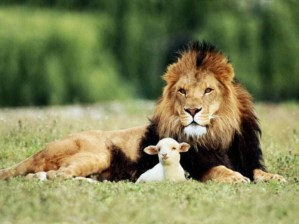
Peace 

Isaiah 11:6-7
“The wolf also shall dwell with the lamb, the leopard shall lie down with the young goat, the calf and the young lion and the fatling together; and a little child shall lead them. The cow and the bear shall graze; their young ones shall lie down together; and the lion shall eat straw like the ox.”

In beautiful, poetic fashion, Isaiah describes the conditions of the world after Christ returns to set up His kingdom. His purpose is to make all things right by establishing a rule of righteousness and peace. One thing is clear, in thousands of years of human governments, man has never been able to rule in righteousness or peace. Even today, with all of our advances, war continues to stain the face of the earth.

While the Bible clearly promises the return, and righteous rule of Christ, it also promises righteousness and peace can rule in the life of all who will receive Christ as Lord and Savior. The Bible refers to Jesus as the Prince of Peace and life. When we allow Him to rule in us, and we live in accordance with His Word, we will find that even in the midst of turmoil, we can have joy and peace.

My prayer is that you will let Christ be king in your life, and live to follow Him.

Pastor Jim


Others 

Philippians 2:17-18
Yes, and if I am being poured out as a drink offering on the sacrifice and service of your faith, I am glad and rejoice with you all. For the same reason you also be glad and rejoice with me.”

Prior to the death and resurrection of Christ, the prescribed manner of worship of God included an elaborate system of sacrifices. Every morning, every evening, and on prescribed dates throughout the year, animals were offered as burnt offerings to provide atonement for the sins of the people. Each of the sacrifices pointed in one way or another to Christ. As the Son of God, His death provided more than all the offerings could ever do. Peter wrote,

“For Christ also suffered once for sins, the just for the unjust, that He might bring us to God, being put to death in the flesh but made alive by the Spirit, . . . ” 1 Peter 3:18

It is not difficult to see a portrait of Christ in the Passover lamb, the scapegoat, or the sin offerings, but what of this drink offering? Did you notice, Paul does not refer to Christ, but to himself as this offering? The drink offering, described in Numbers 15, was designed to accompany the various offerings. If a person brought a free will offering to the Lord, to express thanks to God for who He is, and all He has done, they were to include a jug of wine as a drink offering. This offering did not provide atonement, but accompanied the offering, making the aroma that much sweeter, as it was laid upon the altar. Paul saw his role in the life of others like that. He realized, each individual must present themselves as a living sacrifice, holy and acceptable to the Lord, but he would spend his life helping to make the sacrifice of others sweeter.

As we follow his story throughout the New Testament, we see he exemplifies what it means to love your neighbor as yourself. His whole life was about living for Christ, as an example to others. He spent his time, effort, and energies ensuring the Gospel was declared, and the Christian was well equipped to live for Christ. He risked his comforts and even his life, to bring the message of salvation to those who had never heard.

How do you suppose our impact upon the world would change if we saw ourselves as a drink offering, being poured out on the sacrifice of others? What kind of influence could we have for the kingdom of God, if we looked at ourselves as being in the lives of others, to help them come to Christ, and grow in Him? Writing to the Corinthians, Paul said, “I will very gladly spend and be spent for your souls.” 2 Corinthians 12:15

Let’s determine to live like that, impacting all around us for heaven’s sake.

Pastor Jim


Improved 

Isaiah 10:20-21
“And it shall come to pass in that day, That the remnant of Israel, and such as have escaped of the house of Jacob, will never again depend on him who defeated them, but will depend on the Lord, the Holy One of Israel, in truth. The remnant will return, the remnant of Jacob, to the Mighty God.”

Israel was facing the threat of annihilation. Years of wandering from the Word and ways of God had led them to the brink of destruction, as Assyria mounted their troops in preparation for an all out attack upon them. As bleak as things appeared, God gave a wonderful promise regarding how this judgment would impact the people. Those who walked through this discipline would one day return, having learned to no longer depend upon men, but upon the Lord.

The discipline of God is never without purpose. He does not chasten us with outbursts of wrath but with a calculated approach designed to win us back to Himself. Twice we read of the purpose of His chastening:

Proverbs 3:12
“For whom the Lord loves He corrects, just as a father the son in whom he delights.”

Hebrews 12:6
“For whom the Lord loves He chastens, and scourges every son whom He receives.”

When we wander from the Lord and begin to travel down a path that will lead to our own destruction, the love of God will force His hand to reach out and draw us back. Sometimes, this hand has to come in the form of discipline. Sometimes, this hand delivers the consequences of our actions, but always, this hand is designed to win us back to God, while removing the things that once led us away.

If you are in the midst of difficulties caused by turning from His way, and living according to your own way, perhaps it is time to change direction. The first step is to stop. Stop walking down a path that God cannot bless and will bring His correction. The second step is to turn. Turn around and begin to take strides toward what you know to be pleasing to Him.

Do not despise the chastening of the Lord, it is an expression of His love. He is jealous for you, always desiring what is best for you, both for now and for eternity.

Pastor Jim


When He Comes 

Isaiah 9:6
For unto us a Child is born,
Unto us a Son is given;
And the government will be upon His shoulder,
And His name will be called Wonderful, Counselor,
Mighty God, Everlasting Father, Prince of Peace.”

This is one of the most well known verses in Isaiah, and perhaps in the entire Bible. It is a verse which predicts the coming of the Messiah, seven hundred years before His birth. In this verse, we have a detailed description of the Savior of humanity. We are told a Child will be born, who is in fact, the Son of God.

This verse was originally penned in the midst of extremely dark times in Israel’s history. Externally, they were facing the threat of destruction. The Assyrians began to expand their empire by conquering the nations adjacent to Israel and Judah. Internally, the nation became increasingly immoral. They lost site of the principles upon which they were founded, had wandered from the Lord, and invited the false gods of the surrounding nations into their borders. In earlier chapters, Isaiah describes these conditions by explaining the culture had begun to “call good evil and evil good.”

It is not difficult to see the similarities between Isaiah’s day and our own. Nations are facing the continual threat of terrorism, stemming from the same area of the world where Assyria once ruled. In addition, the tide of immorality is on the rise. It seems to be almost a daily occurrence, where some judge or legislator seeks to impose their personal immoralities upon the rest of us. We are being forced to accept sinful behavior as normal. We are even considered to be bigots, if we suggest that certain lifestyles are unacceptable to God. The Bible is looked upon either as an antiquated fairy tale, or viewed, like many interpret the constitution, as a document that changes to fit the times.

The ambiguous and shifting moral codes being pushed upon our culture are producing all kinds of social chaos. Yet, our leaders refuse to recognize the real cause of the social chaos is immorality and godlessness. We, like Israel, have pushed God out of the way, and as a result, we are experiencing what many call “the wrath of removal;” where God seems to have taken His hand of blessing off of us. We are suffering the consequences of removing God from our lives.

I am so glad in the midst of those dark days, God promised to send His own Son. The Wonderful, Counselor, and Prince of Peace has come to make a way for our sins to be washed away, and a relationship with God restored. Anyone who will receive Christ can have a brand new start in life, and have the hope of heaven. I am also very  glad to know the Savior promised to return. The predictions concerning the first coming of Christ were fulfilled to the letter, and there are three times as many promises of His return, than there are of His incarnation.

The great hope for humanity is found in the pages of God’s Word.

Pastor Jim


What Happened To Me? 

Philippians 1:12-14
But I want you to know, brethren, that the things which happened to me have actually turned out for the furtherance of the gospel, so that it has become evident to the whole palace guard, and to all the rest, that my chains are in Christ; and most of the brethren in the Lord, having become confident by my chains, are much more bold to speak the word without fear.”


As Paul is writing this letter to the church in Philippi, he is chained to a soldier and sitting in a Roman prison. He was incarcerated, not for making foolish decisions, choosing the wrong path, or getting in with the wrong crowd. His imprisonment was due to a rising hostility in the Roman world towards the message of the cross. We might say, Paul was facing difficulties outside of his control. Life is like that. Even when we decide to live pleasing to the Lord, we still face hardship, difficulty and opposition. It interests me what Paul has to say about the results of his hardship.

“The things which happened to me have actually turned out for the furtherance of the gospel, . . .

In the midst of the storm he was facing, Paul realized that while it was creating hardship for him, it was also creating opportunity for others to come to Christ, or grow in Christ. He wrote of how the palace guard had come to know that his chains were in Christ. Rather than whining in prison about how unfair life was, Paul used his circumstances as a chance to tell others about the forgiveness of sins found in Jesus. While it is always easier to speak of Jesus when we are experiencing the blessings of life, the message has an added impact when it is shared through the backdrop of suffering. What a thrilling experience it must have been for those guards, to meet a man who was in prison and was actually innocent. Instead of hearing him complain, and play the blame game, they listened intently as he shared about the love of Christ, and the way of salvation. In Chapter 4, he mentions that the gospel message even reached into Caesar’s household, and many were won to Christ.

“. . .most of the brethren in the Lord, having become confident by my chains, are much more bold to speak the word without fear.”

In addition to the spreading of the Gospel, Paul’s attitude during difficulty, also had a great affect on believers. Those who were once timid and reserved, regarding their faith, found a new sense of boldness to share. A revival broke out in Philippi as one man mustered the courage to share with another about the unsearchable riches of Christ. The most effective evangelism is not through giant rallies, but through one person sharing the love of Christ with another. Evangelism has its greatest rewards when you and I will speak the Word, without fear, to our neighbors, friends, family and co-workers. As we muster the courage to invite them to church, or strike up a conversation with them about the Cross, we demonstrate our genuine interest in them.

Paul saw his circumstances as a backdrop, in which the message of the Cross would have an even greater impact upon those around him. How about you? What is your attitude in the midst of the things you are currently facing? Do you see them as the chains of Christ and use them as an opportunity to share the Gospel with others? There is a world in need of hearing the message of Christ, and we are His mouthpiece. Pray that Jesus would open new doors for you to share His love with others. Who knows what kind of revival might break out, as other believers are stirred to boldness, as a result of your step of faith.

Pastor Jim


We’re Watching 

Isaiah 8:18
“Here am I and the children whom the Lord has given me! We are for signs and wonders in Israel from the Lord of hosts, Who dwells in Mount Zion.”

Isaiah understood something about his life, which is often forgotten today. He realized his life was to be lived as an example. He was a model for others to learn how to follow and serve the Lord. Everything he did, including the way he raised his family, was designed to be a sign to the world in which he lived; teaching them something about the Lord.

Isaiah is not alone in this. Paul declared to his friends they should follow him as he followed Christ (1 Corinthians 11:1). Essentially, Paul was stating, they could learn how to walk with the Lord by looking at the way he lived. Paul went on to say, every believer is an epistle or letter from God, written to the world to teach them how to live for Christ (2 Corinthians 3:2-3). In another place, Paul wrote of how each of us is on display. The whole world is watching and will determine the validity of the Gospel’s claims, based upon the way we live.

God is not expecting perfection from us, but He does require that we see ourselves as witnesses to the world. As much witnessing is done with our actions, as with our words. As we head out the door today, we should realize we are on display; the world is watching. Our lives, and lifestyles are a huge part of a person’s decision to follow Christ.

Pastor Jim


Battleground 

Ephesians 6:14-18
Stand therefore, having girded your waist with truth, having put on the breastplate of righteousness, and having shod your feet with the preparation of the gospel of peace; above all, taking the shield of faith with which you will be able to quench all the fiery darts of the wicked one. And take the helmet of salvation, and the sword of the Spirit, which is the word of God; praying always with all prayer and supplication in the Spirit, being watchful to this end with all perseverance and supplication for all the saints”

In Chapter 5, Paul compared our relationship with Jesus as a walk. Now he compares it to a battleground. We are told we have an enemy, the devil, who plans strategies against us. His goal is to get us to fall into sin, or to live so self-consumed, we have little or no positive effect upon others for the kingdom. As we watch him at work in the pages of God’s Word, we see his method is to use fear and discouragement, as well as to tempt us with the pleasures of the world. Here, Paul explains how we can be prepared for the daily battle we face. His description is of a soldier girded for war. Each element of his armor is designed to deal with a different attack.

The belt of truth refers to the Word of God. Having sound knowledge of Biblical doctrines will keep you from being misled by the subtle schemes of the enemy. Daily reading, and weekly Bible Study, will help prepare you for these attacks. The breastplate protects the heart from mortal wounds. Notice, our breastplate is the righteousness we receive when we trust in Christ for salvation. Daily failures can discourage the believer from moving forward. Those are the times when we look at the cross, remember our sins were paid in full, and His righteousness was given in exchange for simple trust. Since the Christian life is a journey, shoes are important, and we wear Gospel shoes. Everywhere we go, we should seek to take the light of the Gospel of the glory of Jesus with us. When we go on the offensive, we are less likely to be tripped up by the simple things.

Next, Paul mentions a weapon that is, in his own words, more important than all the rest. He states, “above all take the shield of faith.” Faith is critical to our journey and the battle. Faith has become a very mystical word, hard to define. It simply means to trust. If we are going to withstand the enemy’s attacks, we must put our confidence in the promises and warnings of God’s Word. Too often, we ignore the warnings of the Word, thinking somehow we are the exception to the rule. The shield of faith is activated when we choose to trust the Word of God over emotion, circumstances, and the voice of others.

As the breastplate protects the heart, the helmet was designed to protect the head. Head injuries can be mortal or can simply knock us out of the fight for a while. The mind is the battlefield where the enemy discharges his greatest attacks in the night hours, after an argument, before a decision, or in the midst of temptation. The mind becomes a battlefield where war is waged against us. The secret to victory is the helmet of salvation. When we remember what we have been saved from, what we have been saved to, and how God wants to use us in the salvation of others, our minds become filled with the very things which will help us withstand the attack.

Finally, Paul speaks of an offensive weapon. He tells us we have been equipped with a sword, but not just any sword. This is the Sword of the Spirit, defined as the Word of God. Since I have no military training, I am pleased to read that it is the Spirit’s sword. When we open our mouth and begin to share the promises of the Word with others, the Holy Spirit takes those words and uses them like a sword to impact the heart. How often have you heard the Word of God spoken and been convicted, encouraged, empowered or directed? The Holy Spirit will do the same through you, as He has done in you.

Gird up guys, it is time for battle!

Pastor Jim


Then He Said Go

Isaiah 6:7-9
“Your iniquity is taken away, And your sin purged.’
Also I heard the voice of the Lord, saying: ‘Whom shall I send,
And who will go for Us?’ Then I said, ‘Here am I! Send me.’
And He said, ‘Go…’”

Isaiah 6 is perhaps most well known for what Isaiah saw. He records, in the year of King Uzziah’s death, he had a vision of the throne of God. He describes how he saw the Lord enthroned and surrounded by angelic beings, who ever live to give Him praise. What perhaps, is sometimes missed, is what Isaiah heard. He records hearing the voice of God in two distinct ways.

First, an angel took a coal from the altar, touched Isaiah’s lips, and declared God had taken away his sin. In order for Isaiah to receive pardon from God, he had to first recognize he was a sinner, and then allow God to touch him with the coal from the altar. Those coals would have been stained with the blood of the sacrifices. The most important words you will ever hear are, your sin has been taken away. That happens the moment you realize you are a sinner, Christ is the Savior, and you choose to trust in Him. At that moment, all your sins are washed from you. No longer do you have to carry the burden of the guilt from sin, because He carried it for you when He hung on the cross. No words could ever be sweeter than when heaven declares “your iniquity is taken away and your sin is purged.”

Second, once cleansed, Isaiah heard God speak again. This time he was commissioned by God to go into the world with a message. The remaining chapters of Isaiah have to do with that message. Essentially, God is using Isaiah to call others to the Lord. It is important to realize God wants to commission each of us. Something happens to a person who has truly met God, they begin to be filled with a desire for others to know Him as well.

Have you come to Christ and heard Him say “Your sin is taken away”? If not, take this moment to confess you are a sinner, and trust Him as the Savior.

Have you responded to the great commission, where you realize He not only saved you, but is sending you? Before you head out the door, pray God would give you opportunity to invite someone to come hear about Christ, or perhaps He would grant you the chance to tell them yourself.

Pastor Jim


Expanding 

Isaiah 5:14
Therefore Shoel has enlarged itself
And opened its mouth beyond measure;
Their glory and their multitude and pomp,
And he who is jubilant, shall descend into it.”

Sheol is an Old Testament word for the abode of the wicked in death. The New Testament uses the words “Hades,” “Tartarus,” and “Gehenna.” Although different words are employed, they all refer to the final resting place for those who reject Christ, and as a result die in their sins. Isaiah gives a sobering picture when he writes, “Sheol has enlarged itself…” Suggesting that the boundaries of hell are expanding because of the unwillingness of people to respond to the call of God and the cries of the prophet. There are a few things we need to keep in mind.

First, hell is expanding because people are refusing to turn to the only one who can rescue them from its eternal flames. At the same time,  sin was running rampant and people were choosing to live as though there are no consequences for their choices or behaviors, Isaiah and others were boldly and faithfully calling people to come to God. Today things are much like they were in Isaiah’s day. People are calling evil good and good evil. People are receiving awards and national recognition for self-seeking, destructive choices, while those who stand for righteousness are being carted off to jail. They are warned to reconsider their stand against what is clearly forbidden in Scripture. Those who refuse to respond to the call of the Gospel of Christ, will ultimately stand before God and receive just compensation for a life ruled by self. It does not have to end this way. All who call on the name of the Lord will be saved. Past failures and present acts do not keep a person from eternal life. If you are willing to receive Christ, you will be pardoned, rescued, set free and given the free gift of salvation.

Second, hell is expanding because it was never God’s intention for anyone to end up there. Hell was created for Satan, as a place to keep him eternally imprisoned, as retribution for his sin against God and man. Heaven was designed for mankind. Jesus declared that His Father’s house is filled with rooms and He was going to prepare them for us (John 14:2). The work of the cross is like a doorway into eternal life, for all who will walk through it. For a person to end up in hell they must refuse the inner work of the Spirit, the constant opportunities to come to Christ, the pleadings of their friends and family, and the very work the church was left on the earth to accomplish.

Don’t let Sheol expand its borders any farther. If you have not given your life to Christ, do so right now. Pray something like this,

“God, thank you for the cross where Jesus died for me. I ask you to forgive me of my sin and accept me as your child. Help me to leave my sinful ways and begin to follow you. In Jesus name…

Pastor Jim


Love Walks 

Ephesians 5:2
And walk in love, as Christ also has loved us and given Himself for us, an offering and a sacrifice to God for a sweet smelling aroma.”

The Christian life is like a journey. It begins when we put our trust in Christ for salvation, and ends as we cross the finish line entering into glory. In an age of high-speed travel, we often endure the journey for the sake of the destination. I have sat next to people on airplanes who were “white knuckling” the arm rests. I could tell they hate the idea of flying, but it was a necessity in order to reach their destination. The Christian life is not like that. The journey is as important as the destination. Walking, because it is such a slow means of travel, allowed for fellowship, life lessons, and teaching times to take place between Jesus and His disciples. He desires the same for us. As we go through life, we should see each day as a walk with the Lord. A walk in which we can commune with Him and learn from Him. Here in Ephesians Paul exhorts us on how to walk and what paths to take as we journey with Jesus toward glory.

“And walk in love, as Christ also has loved us…”

Whenever the weather allowed it, my parents would take an evening stroll together. I would watch as they walked out the door and down the drive. They were not walking to get anywhere in particular, they were never in a hurry and to my knowledge, they never came back with anything more than what they left with. These walks were simply a time to hang out together and talk about the things which concerned them. Sometimes the discussions would be deep and important, other times light and casual. Though they never used this term, we might call these “love walks.” Paul is reminding us, our walk with Jesus is a walk of love. He reminds us of the love Christ has for us, demonstrated by giving Himself for us as a sacrifice for sin. He then exhorts us to return that love by treating others the way Christ has treated us. If the golden rule is to ‘do to others what we want them to do to us’; this rule is platinum. Love like you have been loved by God. That love involves setting a godly example for others by removing sin from your own life.

“Walk as children of light…”

Light and darkness are often used metaphorically in Scripture. The life we lived before meeting Jesus was a life of darkness. We behaved the way we did because we did not know any better. However, when we met Christ, the light was turned on, and we saw life in a brand new light. Paul is reminding us that in our walk with Jesus, there are paths which we must avoid. Paths leading to the behaviors we were involved in before Christ are off-limits to us. Instead, we should be taking steps toward finding out what is acceptable to the Lord. As you go about your day, facing its opportunities and challenges, what steps do you take to search out what is acceptable to God? Are your decisions based upon what you think, feel, or have heard from others, or do you take time to consider the Word of God, to find the ways of God? Remember, the Psalmist told us, His Word is like “a lamp unto my feet and a light to my path.” (Psalm 119:105)

“See then that you walk circumspectly, not as fools but as wise”

Circumspectly means carefully. By using this word, Paul is reminding us that while we are on a love walk with Jesus, the path we are on has some pretty serious pitfalls. There are times when we face great danger as we walk with the Lord, and the key to success is to be careful. He tells us, this walk is no place for folly. A word that could simply mean not to goof off. We might scold our children to stop fooling around, because the situation is dangerous and they need to be sober-minded. While there certainly is a need to take our relationship with the Lord seriously, the Psalmist used the word ‘fool’ in a different context. He stated, “the fool has said in his heart that there is no God” (Psalm 14:1). The greatest folly we need to avoid as we journey with Jesus, is living as though there is no God. Making decisions without seeking Him, neglecting to spend time in His Word, in prayer, in service, and attempting to do things our own way, or in our own strength, is folly.

Paul reminds us, while we may be walking pretty slowly, time is running out. Soon, each of us will reach the end of our journey, and find ourselves face to face with Jesus. It is important that we take time, today, to consider how we are walking.

Pastor Jim