Exodus 23:2
“You shall not follow a crowd to do evil…”
 The Law of God was given as a standard to show the people their need for a Savior, and as a pattern to ensure that the people lived righteous lives. Here we find a principle that would protect Israel from becoming like the surrounding pagan nations. God is declaring that popular opinion is not what determines right from wrong. Almost every child has heard his parents say, “Would you jump off a cliff if your friends were doing it?” We attempt to instill within our children the principle that just because the crowd is behaving a certain way, it does not make it right. Sociologist refer to “mob mentality.” They say it is possible for individuals to lose the ability to think for themselves, and begin to follow whatever the crowd is doing. Living in a democratic state can make this even more complicated. God declares to Israel that popular vote is not the standard of righteousness. If all the people vote to erect a golden calf to represent God, that does not make God a gold cow. His righteous standard will never be changed simply by getting a crowd to reject it.
We live in a time, perhaps like no other, where the Word of God is challenged. The very foundational principles of righteousness are being questioned, ridiculed, and legislated away. We need to keep in mind that righteousness is not a floating standard that can be voted upon. No matter what society tells us, God has a standard of right and wrong, and we must not follow a crowd to do evil.
Pastor Jim
 The purpose of Israel’s time at Mount Sinai was to develop as a nation upon the foundation stone of the Word of God. Moses went up the mountain alone, and came down the mountain with clear and detailed instructions from heaven regarding how the people should live. These instructions are referred to simply as “The Law” and can be divided into three groups. The Moral Law is a list of unchanging standards God set upon mankind. The Religious Law was designed to instruct the people regarding relationship with God, and the Civil Law was created to keep order. Since God was forming this traveling band into a nation, it would be necessary to also establish leadership, and because of the nature of men, it would not be long before the people would begin to complain about those who are in charge. Knowing this was coming, God declares,
 A paradox is a statement that seems contradictory or opposed to common sense, but is true. The statement Jesus reveals is one of life’s greatest paradoxes. Man was created to know God. Jesus said that He came to “give us life and that more abundantly.” When our lives are lived in complete obedience to the Lord, we experience the height of living. When we hold back, unwilling to give ourselves, our time, or some sinful activity; we think we are gaining, we think we are better off. That very thing we are holding onto, is the very thing keeping us from the abundant life Jesus created for us.
 Paul often referred himself as a servant, or a slave. The word he used was “dulous”, which means bond-slave, or a person who was bound to another. It is not difficult to find examples in history of people who have been enslaved. Some are slaves because they were conquered in battle, others for religious or ethnic persecution, and still others because of debt or a criminal offense. It is quite difficult, however, to find examples of people who chose slavery as a way of life. I suppose no ambitious students ever pursued slavery as a career path, seeking a university that offers a good slave training program. Yet Paul refers to himself as a bond slave of Christ. Exodus 21 gives a vivid picture of why Paul would choose to be a slave.
 Man was created with a need to know God. In fact, we only experience the fullness of life when we are in right relationship with God. Man, apart from God, is like an expensive luxury car, purchased only to sit in the driveway under a cover. That is not what it was designed to do. Nor were we designed to live apart from God. That is why there is a longing in our hearts to know God. This longing shows itself in worship; every man worships something. God’s answer to this was to send His Son, so we could know Him. Man’s answer is to become incurably religious. Like an old miner who hits a vein of fool’s gold; so many have satisfied their soul’s longing for God with religious practices.
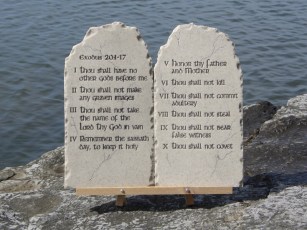 On the top of a mountain covered in smoke, Moses met with God, and heard the standard upon which relationship with God would be established. The Lord gives a list of ten commands that reveal His holiness, and our need for sacrifice. The first four commands reveal things about the nature of God. We learn, along with being jealous, just, merciful, faithful and holy, He is also the only true God and must not be reduced to an image or an idol.
 I imagine if any of the people in this massive caravan were asked where they were headed, they all would have given the same answer, “We are going to the Promised Land.” They had grown up with stories of a land flowing with milk and honey; had been dreaming of this day for generations. Their goal was to reach a land where they were free from the tyranny of Egypt. At the same time, if we were able to look up and ask the Lord where this multitude of people was headed, His answer would not be the same. To Him the destination was somewhere entirely different. God said “I am bringing them to myself.”
 The phrase “He could do no mighty work there…” has always fascinated me. Think about it. The one who healed the sick, calmed the seas, rebuked the demons, raised the dead, created all things, and by the word of His power, holds all things together, could do no mighty work there. Why? What is it that kept the mighty God from accomplishing His mighty works.
 When the sojourning camp of Israel reached Rephidim, they were horrified to discover there was no water. There are many things in life we view as necessities, which are actually comforts; water is not one of them. A person can survive in difficult desert conditions for about three days without water. Their situation was grave, to say the least. This truly could have been the end for Israel. As the people assessed the problem, the only solution they could come up with was to return to Egypt. They knew if water was not discovered quickly, they would certainly perish.
 Jim Gallagher